Abstract
Rei Kawakubo of Comme des Garc¸ons is an anomaly in fashion’s celebrity-designer, brand-driven world. Intensely private, she rarely gives interviews; instead she expects those wanting to understand her work to look at the clothing itself. So, when she released a “creative manifesto” that offered insight into the Comme des Garc¸ons spring/summer 2014 collection, it made an impression. In the manifesto, Kawakubo claimed to “break the idea of ‘clothes’”, and, certainly, the accompanying collection, Not Making Clothing (spring/summer 2014), represented a new degree of abstraction in the designer’s repertoire that was then amplified in following collections. Bypassing the common response to explain away Kawakubo’s work as art, anti-fashion or a refusal of fashion, in this article the author approaches the manifesto itself as one of Kawakubo’s “works”. Pulling at its threads to unravel the seams of the text, the author begins with its “making” and weaves in and out of the history of the fashion manifesto to compare Kawakubo’s work with the fashion manifestos of the Futurist artists Giacomma Balla and Volt. The author then comes back to the clothes themselves. In breaking the idea of clothes, the author argues, Kawakubo puts into doubt what we take for granted, changing what clothes signify and intensifying the normal work of fashion.
Kawakubo
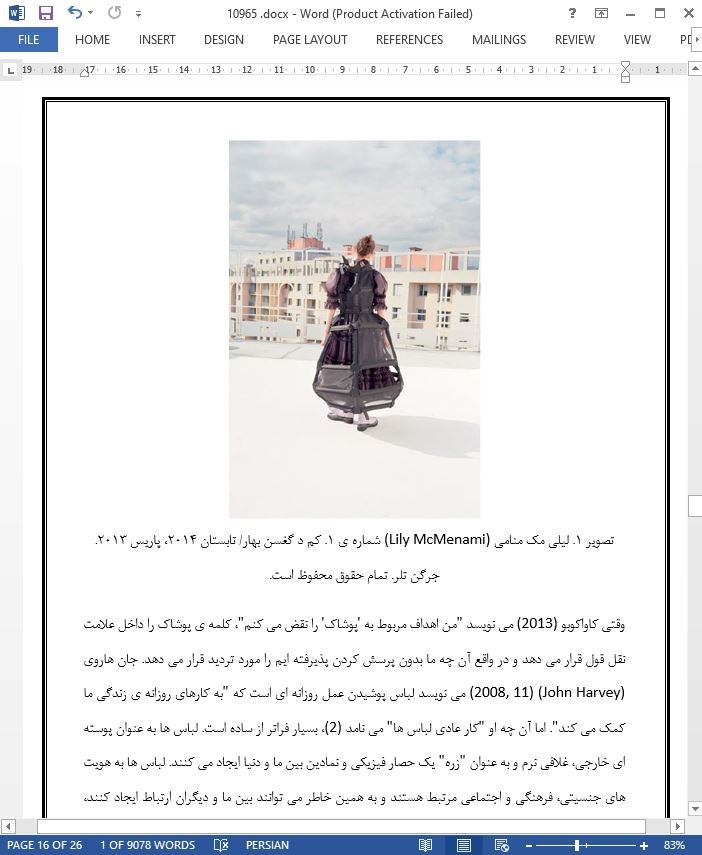
Rei Kawakubo is a famously, intensely private person. An anomaly in high-end fashion’s celebrity-designer, brand-driven world, she stopped taking the customary post-collection bow on the catwalk years ago. She rarely gives interviews, expecting instead anyone who wants to understand her work to look at the clothing itself. So, in October 2013, when the high-profile website Business of Fashion published a “creative manifesto” written by the founder of Comme des Garc¸ons, it made an impression. Kawakubo did not say any of the things that designers usually say about the creative process. Art, fashion history, films and travel had as little to do with the creation of the Comme des Garc¸ons spring/ summer 2014 collection, Not Making Clothing, as “seeing new shops, looking at silly magazines [or] taking an interest in the activities of people in the street” (Kawakubo 2013).1 Because these things already existed they could not help her find something new. What she wants, what she has to wait for, is “the chance for something completely new to be born within myself”. In order for this to happen, she wrote, “I tried to think and feel and see as if I wasn’t making clothes” (Kawakubo 2013).
Notes
1. The titles applied to Comme des Garc¸ons collections are derived from the typically cryptic and riddle-like directives provided by Kawakubo to journalists and so can be inconsistently applied in reportage and commentary of the designer’s shows. In this article, where relevant, I have employed the titles as listed in the exhibition catalogue for Rei Kawakubo/Comme des Garc¸ons: Art of the In-Between (Bolton 2017).