Abstract
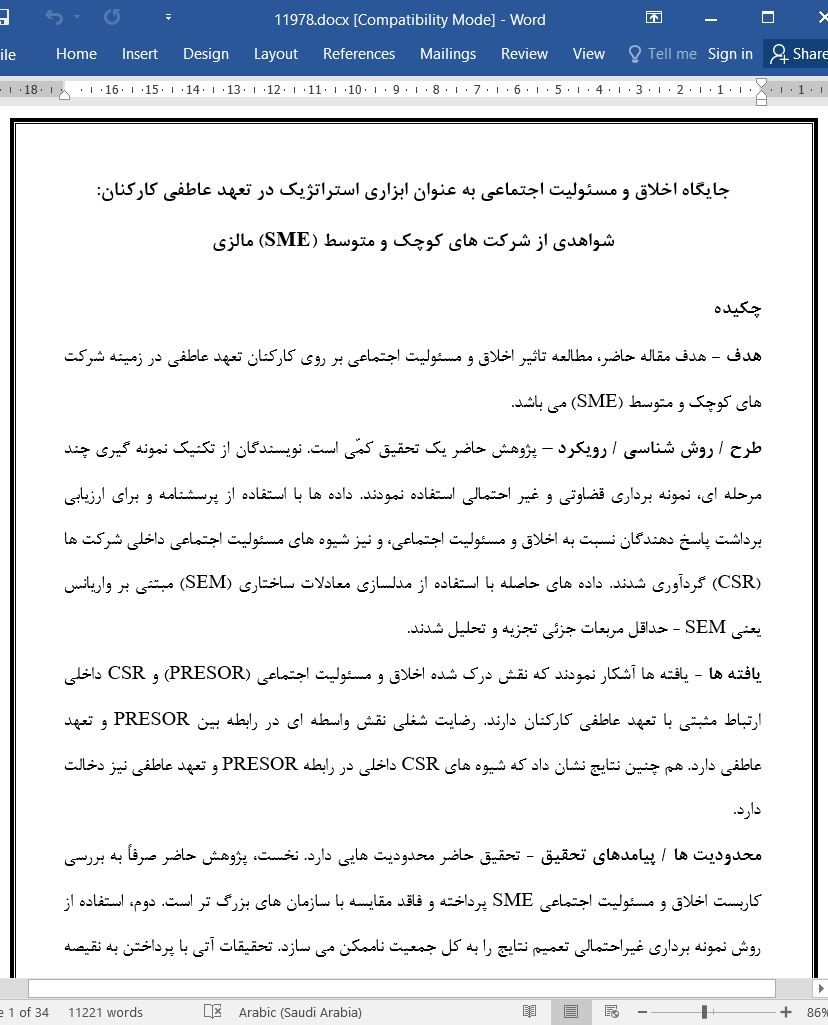
Purpose – The purpose of this paper is to study the impact of ethics and social responsibility on employees’ affective commitment in the context of small and medium-sized enterprises (SMEs).
Design/methodology/approach – This is a quantitative research. The authors employ multistage sampling technique, non-probability and judgmental sampling method. Data were collected through questionnaire survey to measure the respondents’ perceptions of the ethics and social responsibility, as well as internal corporate social responsibility (CSR) practices. The data obtained were analyzed through variance-based structural equation modeling (SEM), i.e., partial least square SEM.
Findings – The findings reveal that perceived role of ethics and social responsibility (PRESOR) and internal CSR are positively related to employees’ affective commitment. Job satisfaction is found to be mediating the relationship between PRESOR and affective commitment. The result also showed that internal CSR practices mediate the relationship between PRESOR and affective commitment.
Research limitations/implications – There are few limitations in the present research. First, present research merely investigates the practices of ethics and social responsibility by SMEs and did not perform a comparison with larger organizations. Second, the use of non-probability sampling method is unable to generalize results for the entire population. Future research could address the shortcoming of present research in order to further contribute to the academic and business world.
Practical implications – The findings provide insights to entrepreneurs and SMEs on the manifestation of ethics and social responsibility in enhancing employees’ affective commitment. In turn, it reduces employees’ turnover intention and enhances SMEs sustainability to strive in the competitive environment.
Social implications – These findings highlight the positive chain effects of enterprises in discharging their moral obligation as well as their social responsibility. The enterprises are benefited from the good reputation which may act as a magnet to attract talent-employees and also sustaining their enterprises through employees’ retention.
Originality/value – This research paper contributes to current knowledge by painting a better picture on the importance of ethics and social responsibility and internal CSR from the employees’ perception. As to date, employees’ perception of ethics and social responsibility and internal CSR practices are still under-investigated. Moreover, past research often focuses the impact of ethics and social responsibility in the larger corporation but scant research is conducted in the smaller organization such as SMEs.
Introduction
Globally, small and medium-sized enterprises (SMEs) are recognized for their substantive role in promoting economic development and growth for sustainable development. SMEs contribute to the economic development through jobs creation, increasing income levels and equalizing income distribution. According to The World Bank (2015), SMEs contribute approximately 45 percent of total employment and up to 33 percent of national gross domestic product in emerging economies. A recent study conducted in Malaysia revealed that SMEs dominate Malaysian economy in a similar manner. In 2015, SMECorpration reported that SMEs contributed 65.5 percent of total employment and 17.6 percent of total exports of Malaysia. Despite its significant importance in Malaysia economy, SMEs face multiple challenges. Ahmad and Seet (2009) mentioned that the estimated failure rate of Malaysian SMEs is as high as 60 percent. This indicates that SMEs in Malaysia are in the critical stage and face serious obstacles to stay competitive. To mitigate these challenges, several suggestions are put forth including the incorporation of ethics and social responsibility to increase competitiveness and sustainability