ABSTRACT
An anatomically detailed 3-D computer graphic model of the eye and surrounding face within a virtual environment has been implemented for use in a surgical simulator. The simulator forms part of a teleoperated micro-surgical robotic system being developed for eye surgery. The model has been designed to both visually and mechanically simulate features of the human eye by coupling computer graphic realism with finite element analysis.
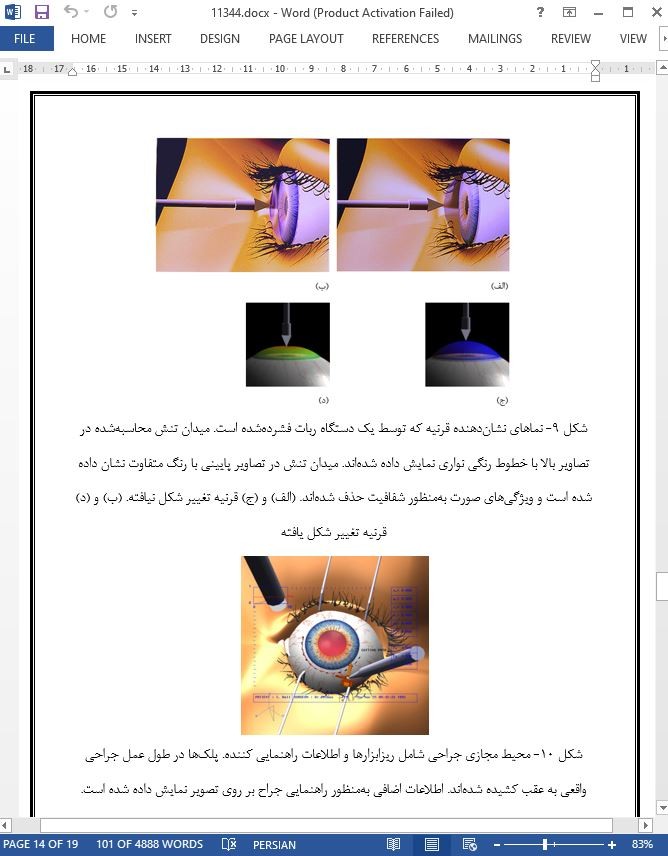
The paper gives an overview of the system with emphasis on the graphical modelling techniques and a computationally efficient framework for representing anatomical details of the eye and for finite element analysis of the mechanical properties. Examples of realistic images coupled to a large deformation finite element model of the cornea are presented. These images can be rendered sufficiently fast for the virtual reality application.
1. INTRODUCTION
We are developing a teleoperated micro-surgical robot for eye surgery. In order to provide simulation for training and to assist during surgery a virtual environment has been implemented as part of the system. During a simulation, the surgeon operates the robot in exactly the same way as it would be used when performing actual surgery.
This paper describes our efforts to create anatomical realism in a virtual environment for eye surgery involving visual and mechanical simulation. It provides a framework for the coupling of computer graphics for visual realism with finite element analysis and input from physical instruments.
12. CONCLUSIONS
A surgical virtual environment containing a detailed model of the eye has been implemented for use in a teleoperated microsurgical robotic system for eye surgery. Visual and mechanical simulations have been combined by the coupling of parametrically defined graphic realism and finite element analysis. The virtual environment produces a fair level of realism (adjustable) for a low display regeneration time on a desktop workstation and gives sufficiently fast performance (>10Hz) on a high end workstation. It now forms part of a prototype micro-surgical robotic system.
Interest has been expressed in using the model for anatomic teaching, as it allows students to select and view each anatomical structure individually.