Abstract
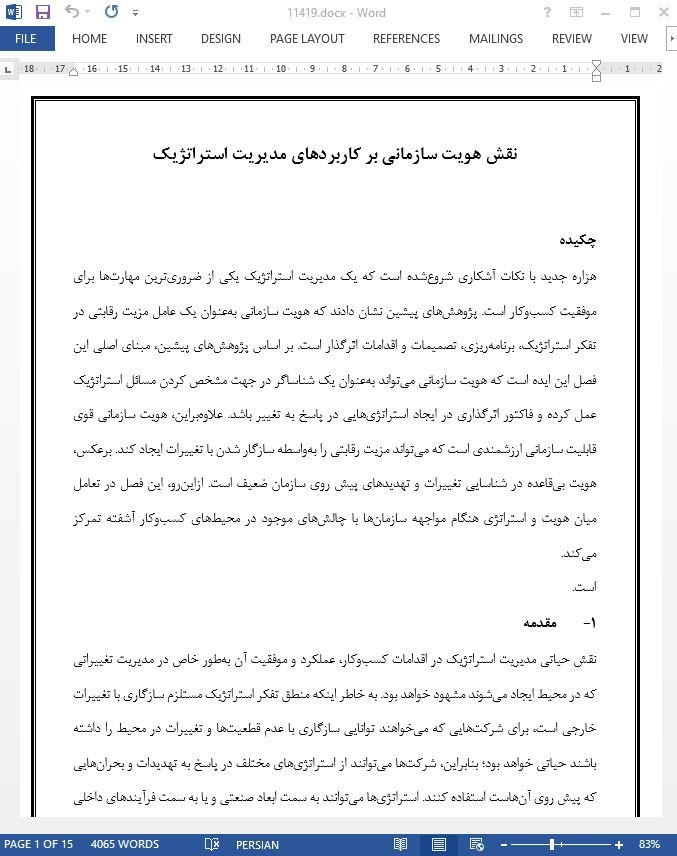
The new millennium started with evident hints that strategic management is one of the most required skills for business success. Previous research has shown that as a competitive advantage factor, organizational identity affects strategic thinking, planning, decisions and actions. Based on the past research, at the core of this chapter lies the idea that organizational identity can act as a detector for identifying strategic issues and can be an influential factor in developing strategies in response to change. Moreover, a strong organizational identity is a valuable organizational capability that can create competitive advantage through its urge to adapt to changes. Conversely, a loose identity is weak in detecting changes or threats directed to the organization. Thereby, the chapter focuses on the interaction between identity and strategy when organizations face challenges in the turbulent business environment.
1 Introduction
The vital role of strategic management on business operations, performance and success becomes apparent especially in managing changes that arise in the environment. As the logic of strategic thinking requires adaptation to external change, it is pivotal for firms to develop the ability to cope with uncertainties and changes in the environment. Accordingly, firms can use various strategies for responding to changes or crises they face. Strategies can be either directed outward at industry dimensions or inward toward the internal processes of the firm (Chattopadhyay et al. 2001). As an internal capability, the identity of an organization is a facilitating factor in achieving competitive advantage and a “strategic tool” for positioning in the market (Stensaker 2015). Hence, identity is not an issue that can be separated from the strategic thinking of the organization.
5 Conclusion
Leaving big question marks on their legitimacy, environmental challenges bear witness to the collapse of many institutions and enterprises. However, organizational identity as a valuable organizational capability can embrace and support the reformation of strategic thinking and activities in responses to the changes. Also, the interaction of identity and strategy is critical as both have their own ways of responding to changes in the environment. Moreover, both constitute the cognitive terrain of organizations in shaping the perceptions and behaviour of those involved in a firm’s activities. Strictly speaking, identity and strategy influence each other, and the alignment of identity and strategy helps firms to reach organizational targets in a more efficient and effective manner.