Abstract
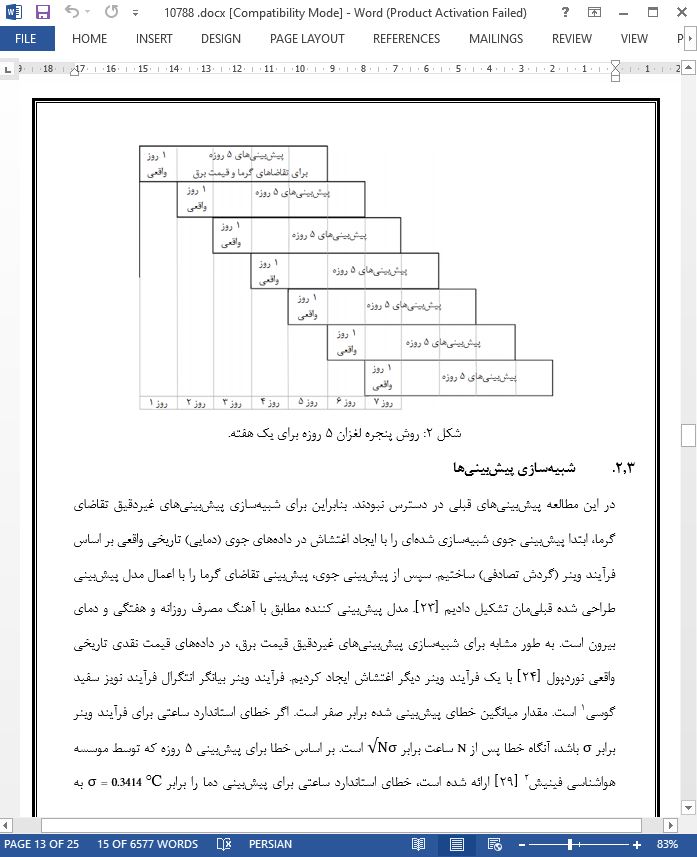
A combined heat and power (CHP) optimization model with heat storage is proposed to minimize the production cost and to maximize the revenue from power sales based on a sliding time window method. The model can be applied both for operating heat storage optimally and supporting investment planning for a new storage. Heat demand is forecasted based on a weather forecast. Each day the heat demand and power price forecasts are input to a generic CHP optimization model for a several-day time window to obtain a heat storage operation plan. Then only the first day of the plan is implemented with actual power price and heat demand using a single-day optimization model to compute the actual production amount, fuel costs and revenue from power sales. After that, the time window is slid one day forward, and the above-mentioned process is repeated. In the test runs, forecasts for power price and temperature are simulated by disturbing actual (historical) data by the Wiener process (random walk). To evaluate the benefit and validate the proposed method, the results are compared with the no-storage case and the theoretical optimum assuming perfect demand and price forecasts. The results show that the revenue from power sales can be significantly improved. The method is used to evaluate the benefit of different sized storages for the CHP system. Also the effect of the width of the time windows on the performance of the method is evaluated. The model was tested using real-life heat demand data for the city of Espoo in Finland, and NordPool spot market data for power price for a one year time horizon. The results indicate that considering the forecasting uncertainty, 5-day sliding time window method can obtain 90% of the theoretically possible cost savings that can be derived based on perfect forecasts.
1. Introduction
Combined heat and power (CHP) is a booming technology which simultaneously produces heat and power by recovering heat that would otherwise be wasted in conventional condensing generation of electric power. Since 2007, the European Council has targeted to tackle several serious climate change and energy related issues. In details: 20% CO2 emissions reduction comparing to 1990; 20% improvement in energy efficiency; 20% share of renewable energy sources in the end-use, which is called 20–20–20 goals, should be acquired by 2020 [1]. CHP is considered a sustainable and economic technology to fulfill those abovementioned goals for its significant performance in fuel demand reduction, greenhouse gas reduction and fossil fuel independency [2]. For instance, biomass-fired CHP plants are technically and economically advantageous for carbon emission reduction given the proper system efficiencies, fuel costs, incentives, thermal energy usage, etc. For small scale CHP, Micro-CHP units are considered to replace conventional boilers in home installations. The production of electricity simultaneously with the generation of heat yields an economic benefit for the user. Also, the fossil fuel consumption and CO2-emissions are effectively lowered. These good performances for micro-CHP are evaluated in [3,4]
.6. Discussions and conclusions
We have introduced the sliding time window method for planning CHP production and heat storage operation. We have demonstrated the method using heat demand data for the city of Espoo and power price information from NordPool. The method is designed to use uncertain forecasts for heat demand and power price. In the test runs, using a 5-day time window, our method obtained 90% of the theoretically possible savings that can be derived based on perfect forecasts. However, the savings depend on how non-coincident the heat demand and power price curves are, and also on the accuracy of the forecasts. In this study the forecasts were simulated by disturbing actual data by the Wiener process. When applying the method in real life, real forecasts should be applied.