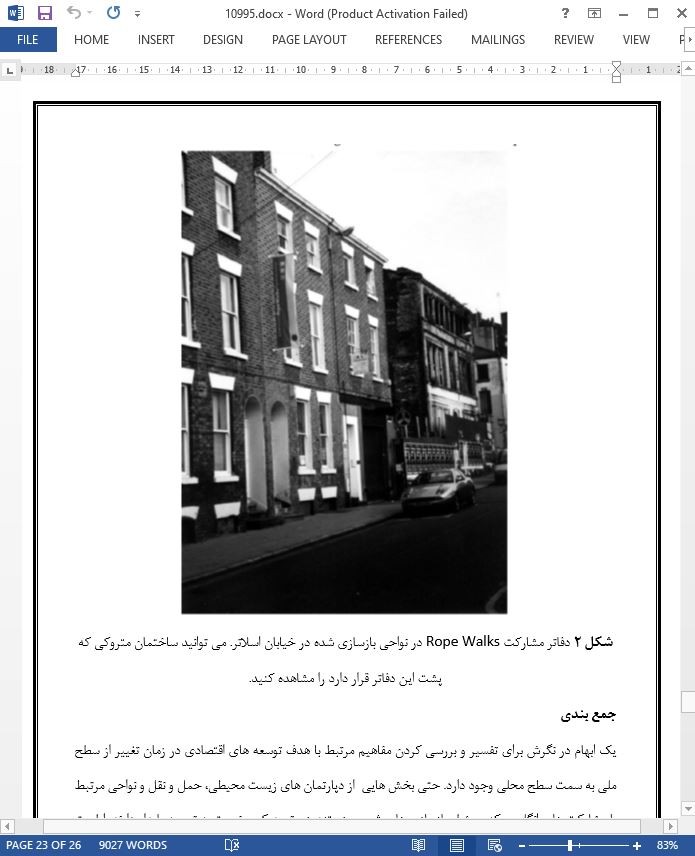
Despite the emergence of urban regeneration and sustainable development as parallel strands of British urban policy, there has been little co-ordination between them and an imbalance in action with greater emphasis given to achieving urban regeneration, especially economic regeneration, than to sustainability. It can be argued that all urban regeneration contributes to sustainable development through the recycling of derelict land and buildings, reducing demand for peripheral development and facilitating the development of more compact cities. But below this strategic level British urban policy has yet to fully address the requirement for more sustainable development. This paper addresses this question through an examination of policy in Liverpool and a case study of Duke Street/Bold Street (the Rope Walks Partnership): a mixed use area adjoining the city centre. It is important to place local action within the context of national policies and so the paper begins with some discussion of the extent to which the principles of sustainable development are included within national urban regeneration policies before going on to examine policy at the metropolitan scale in Liverpool and then at the more detailed level of the Rope Walks area. The conclusions suggest that it is economic regeneration and more precisely property redevelopment, that is the main driving force regenerating the area and that there is some way to go before the city or the case study area achieve an environmentally sustainable regeneration process.
Introduction
Regeneration has become a major element of British urban policy. Since the passing of the Inner Urban Areas Act in 1978 an array of initiatives has been introduced, culminating in 1993 with the introduction of the Single Regeneration Budget and the regeneration agency for England: English Partnerships. Since the early 1990s, environmentally sustainable development has also emerged as an important element of urban policy. In Sustainable Development: the UK Strategy (1994) the Government recognised the importance of urban regeneration in contributing to a sustainable pattern of development that uses “the already developed areas in the most efficient way, while making them more attractive places in which to live and work” (Department of the Environment, 1994, p. 158).
Conclusions
From the national to the local level there is an ambivalent attitude to sustainable development and a constant attempt to compromise and reinterpret the concept to support the aim of economic development. Even those parts of the Department of the Environment, Transport and the Regions and English Partnerships responsible for urban regeneration policy have only a limited commitment to sustainable development. The first priority of the Liverpool Unitary Development Plan is clearly to tackle the city’s economic problems. Although the UDP offers some protection to local environmental quality, townscape, landscape and built heritage, it is much weaker in making a contribution towards global sustainability. Whilst Liverpool’s LA21 espouses sustainable principles there is little evidence of them being implemented in the regeneration of the Rope Walks area.