Abstract
Maintaining profitability measures while conducting business through environmentally and socially sustainable operations is an optimization challenge for organizations globally and for our society. Aiming to contribute to the research streams on this global challenge, this paper studies the state of the art literature on two management methodologies along with sustainability management from an integration perspective: quality management with its intraorganizational focus and supply chain management with its interorganizational view. The paper establishes key themes, trends and new avenues for research through a structured systematic review. The systematic review undertaken includes both descriptive analysis and thematic synthesis of state of the art quality management, sustainability and supply chain management integration literature. Integration synergies of quality and supply chain management were established including performance improvements and integration increasing the effect of both methodologies. Incorporation of sustainability into quality and supply chain management was identified to be a highly emerging area with multi-dimensional (financial, ecologic and social) approaches highly in need for more sustainable supply chains. Ultimately, a new, emerging research area was revealed: sustainable supply chain quality management. Although, several reviews were conducted on the quality, supply chain and sustainability management practices, this study is one of the very few, undertaken from the perspective of all three approaches and cumulative integration. This contribution provides an initial theoretical framework to guide future theory building on a fruitful research avenue.
1. Introduction
Customers, legislation bodies and other interested parties are demanding higher business performance from organizations environmentally, socially and financially through responsible management of products, processes and services. Consequently, sustainability management (SM) is now a strategic parameter for the continuity of businesses, for satisfying the current society needs while not sacrificing the ability of meeting future needs. Achieving triple bottom line (TBL) performance which is hitting economical profitability measures while continuously improving on environmental and social impact levels through synergistic policies and strategies is an intricate matter for the industry and sustainability field (Rajeev et al., 2017).
5. Conclusions
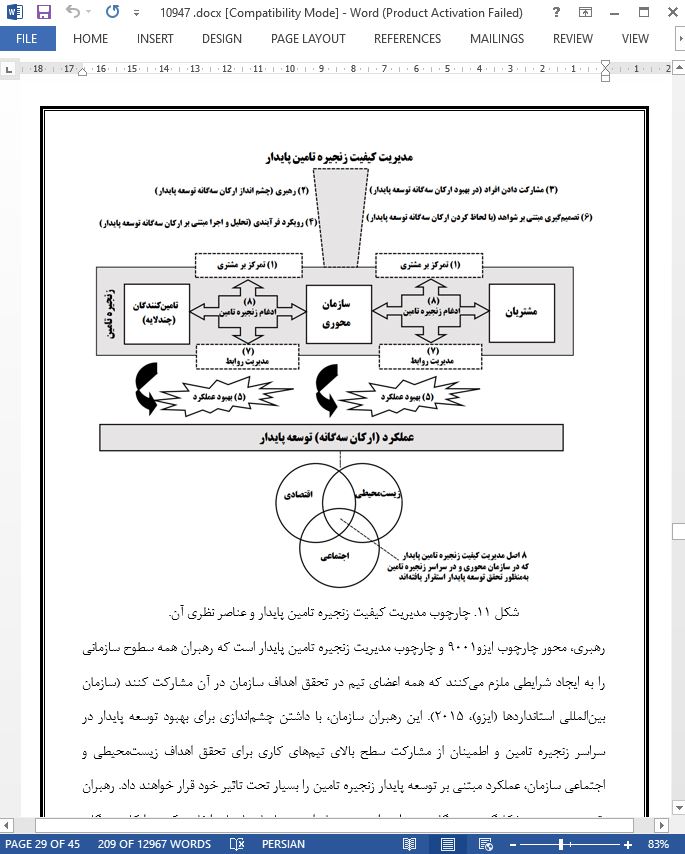
In this paper, a systematic review of the quality management, supply chain management and sustainability management integration literature was undertaken, with a view to explore unrevealed potential for integration. 93 papers were identified as relevant to this review between 2005 and June 2017. The descriptive statistics of the literature were provided along with the key themes covering the integration research streams, presented in a concept map format. Significant benefits of integrating quality and supply chain management were established including performance improvements and integration increasing the effect of both methodologies. Integration of sustainability into quality and supply chain management was seen to be a highly emerging area with multi-dimensional (financial, ecologic and social) approaches still very much required to enable more sustainable organizations and supply chains for our society. In the light of this in-depth review, a new, emerging research area was revealed: sustainable supply chain quality management (SSCQM). An initial theoretical framework was provided to guide future theory building on this promising research area, building on the integration potential of quality management across the supply chains and incorporating triple bottom line for sustainability improvements.