Abstract
Introduction The studies suggesting the prevalence of Obsessive-compulsive disorder is scant in the region of Saudi Arabia and more so in a population sample of medical and paramedical students. The aim of this study was to estimate the prevalence of obsessive-compulsive symptoms in a community sample of students of applied medical sciences. Furthermore, an association between obsessive compulsive symptoms and various sociodemographic variables and several aspects of academic life were investigated.
Methods This cross-sectional study recruited 404 university students belonging to four departments. Tools used in the study included Obsessive compulsive inventory revised (OCI-R), DSM-IV criteria for diagnosis of OCD and Y-BOCS severity rating scale. The main outcome would be probable obsessive compulsive disorder (OCI-R score>21). The students with >21score were further evaluated for the presence of obsessive compulsive disorder using DSM-IV criteria and Y-BOCS.
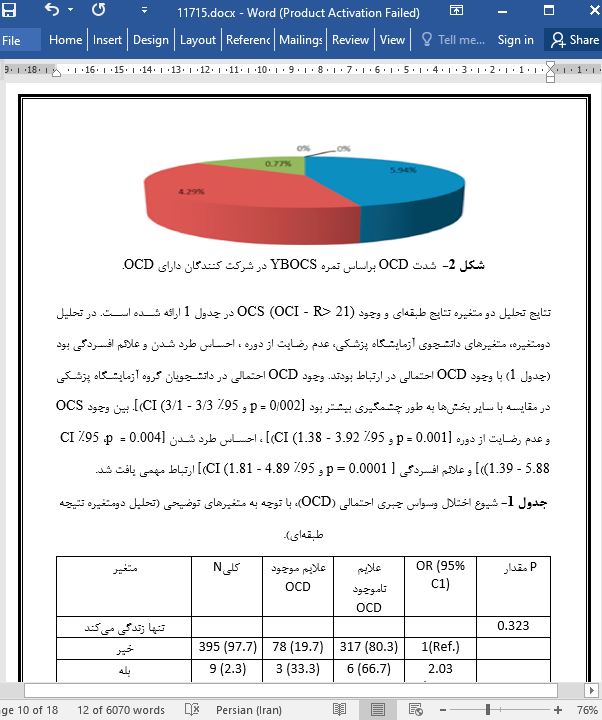
Results The prevalence of OCS was 20% [95%CI (19.902–20.098)] with the OCI-R screening tool. Actual prevalence of confirmed OCD was 5.06% [95%CI (4.39–6.12)]. Presence of probable OCD was significantly high [p = 0.002 and 95%CI (1.31–3.53)] in students of laboratory medicine department. A significant association was found between presence of OCS and dissatisfaction with the course selection [p = 0.001, 95% CI (1.38–3.92)], feeling of rejection [p = 0.004, 95%CI (1.39–5.88)] and depressive symptoms [ p = 0.0001 and CI (1.81–4.89)]. Our sample was limited to college age women, therefore the interpretation of prevalence my not be generalizable.
Conclusion The presence of such a disorder is likely to effect academic performance, quality of life and interpersonal relationships hence, identification and treatment at the right time help improve academic performance and quality of life.
1. Introduction
“Obsession is defined as an unwanted intrusive thought, doubt, image, or urge that repeatedly enters the mind”. Obsessions are anxiety provoking and ego-dystonic which means they are incongruous with the person’s beliefs. The individual often regards the intrusions as illogical and exaggerated and tries to resist them. Obsessional thoughts typically include fears of illness and contamination, unwanted aggressive thoughts, other taboo thoughts involving sex or religion, and the need for symmetry or exactness. “Compulsions are repetitive behaviours or mental acts that a person feels driven to perform in response to an obsession”. They are mostly involuntary and are seldom resisted (American Psychiatric Association, 1994). A compulsion can be either an overt action observable by others (such as checking that a door is locked, cleaning, arranging and reassurance seeking) or a covert mental act that cannot be observed (such as repeating a certain phrase in the mind). Compulsions, generally serve to neutralize the distress and anxiety produced by obsessions (Goodman et al., 2014).
5. Conclusion
The prevalence is limited to the sample of college age women with limited generalizability. OCD and subclinical OCD are not uncommon in the community more so in medical and paramedical students, both being associated with significant comorbidity. Therefore, it is important that both are identified and treated in the community because of associated morbidity. The presence of such a disorder is likely to affect the cognitive capacity, academic performance, quality of life and interpersonal relationships. Hence, identification and treatment at the right time help improve academic performance and quality of life.