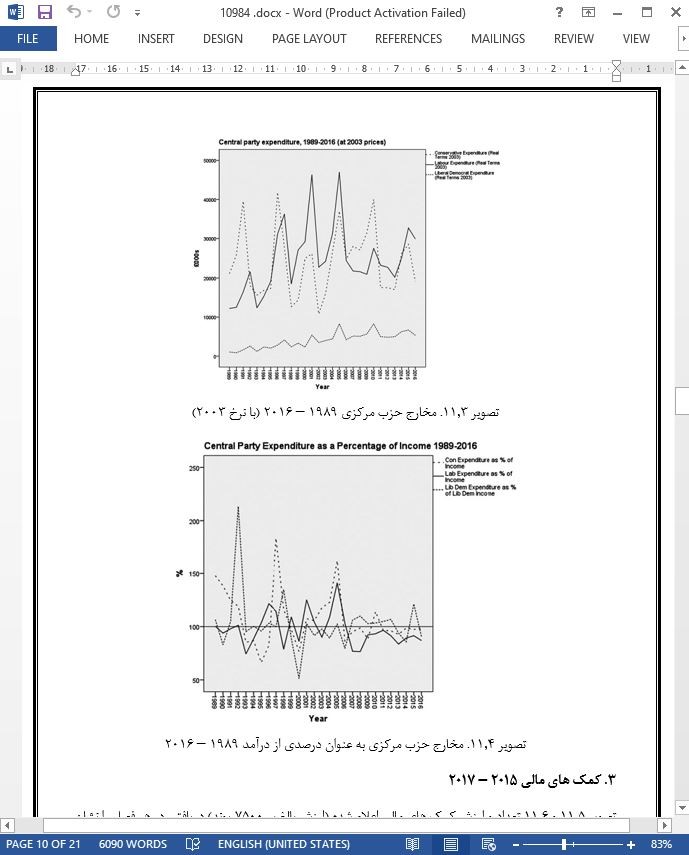
With an election having taken place only two years beforehand, there may have been an expectation that little would change in terms of party finance. Yet the period between the 2015 and the 2017 elections demonstrated a surprising amount of change. There were new laws and policies related to party finance and much uncertainty about the legitimacy of some election spending. Moreover, as other chapters also show, the two main opposition parties were fundamentally changed—not only in terms of leading personnel—but also in respect of financial prowess, largely due to an influx of new members and supporters. But despite change, there was also continuity. The national campaign continued to be subsumed into playing a supporting role for the battles in the constituencies, and the growth of digital campaigning continued, though it was still far from the dominant mode of campaigning, especially in terms of expenditure. And, by polling day, ‘normal service’ was resumed in terms of party income and expenditure, with the Conservatives able to raise significant sums once the election was called. But all of this should also be contextualised by the sudden calling of the election. As this chapter shows, its unexpected nature impacted significantly on parties’ spending decisions and their ability to use their money effectively.
1. Developments in party finance rules
While both the 2005 and 2010 Parliaments saw extensive reviews of party finance regulations (Fisher, 2010, 2015), there was no such review during this short Parliament. There were still important developments, however, which had wider implications for funding more generally. Two of these were a result of government policy. The third may result in criminal prosecution. The first was initiated soon after the 2015 election. In July 2015, a Trade Union Bill was presented, which included a clause requiring trade unions with a political fund to operate a ‘contracting-in’ system rather than a ‘contracting-out’ one. This went to the heart of the Labour Party’s relationship with the trade unions, which—following the Trade Union Act 1913—established that for trade unions to engage in political activity, they must create a separate political fund. This covered all political activity—not just that with the Labour Party—and trade union members were actively required to ‘contract-out’ if they wanted to avoid paying the modest additional fee. The 1913 Act laid the ground rules for an important aspect of Labour funding for much of the next 100 years. Political activity through the Labour Party would be expressed collectively through a union’s decision to affiliate to the party.
5. Conclusion
The sudden calling of the general election in April 2017 had significant implications in terms of party finance. At the start of the year, Labour was in the relatively unusual position of being at a financial advantage relative to the Conservatives—ironically, in part due to the instability surrounding the party’s leadership between 2015 and 2016. But by the time of the election, the Conservatives had re-asserted their financial dominance, raising very significant sums in a short period of time. In the longer term this initial advantage for Labour may be more difficult to achieve, since there will not be the one-off events of leadership elections generating new income, and the effects of ‘contracting-in’ for new trade union members may be unpredictable.