Abstract
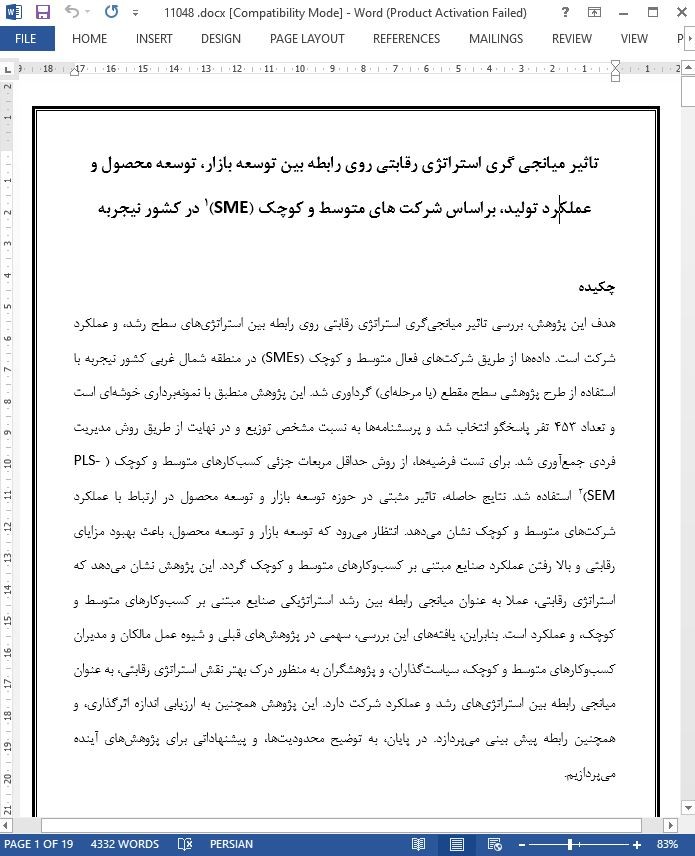
The aim of this study is to examine the mediating effect of competitive strategy on the relationship between growth level strategies, and firm performance. Data was compiled from the manufacturing based SMEs operating in the North-West region of Nigeria, using cross-sectional research design. This study adopted cluster sampling and randomly selected 453 respondents and questionnaires were proportionately distributed and collected through personally administered method. PLS-SEM was used to test the hypotheses. The results found positive impact to both market development and product development on the SME performance. It is expected that market development and product development will improve the competitive advantage and enhance performance of manufacturing based SMEs. The study found that competitive strategy empirically mediates the relationship between the strategic growth of manufacturing based SMEs and performance. Therefore, the findings of this study contribute to the literature and practice of SMEs owners-managers, policy makers, and researcher with better understanding on the role of competitive strategy in mediating the relationship between growth strategies and firm performance. The study also assessed the effect size, as well as the predictive relevance. Finally, limitations and suggested for further studies were represented.
1 Introduction
The focus of today's business operations, for both developed and developing countries, is how to improve Small and medium enterprises (SMEs), towards growth and sustainability. Hence, Small and medium enterprises (SMEs) are gaining more concerned from institutions, for example; NonGovernmental Organization (NGO), research institutions, practitioners and so along. Moreover, SMEs has been realized as the engine of economic growth and development, not only to the developing economies, equally the developed countries to benefits enormously from the SMEs (Kongolo 2010). SMEs contributes greatly to job creation, youth innovation, increases production, technology growth, resource utilization, GDP and above all the poverty reduction (Abiodun 2014; Washington 2014).
7.2 Limitations and Direction for Future Studies
This finding of this study has some limitations. First the study was limited to two growth strategies of Ansoff, and only one Porter’s generic typologies, hence, an extension of this work would be interesting to examine the the relationship between growth strategy, competitive stratey and performance that include sample of both small and large manufacturing based firms. That would enhance the researchers understanding and support further generalizability of the findings. Also, the measeurements of variables used in this study was limited to adapted measures from the Western countries, future studies may develop indicators that may more appropriate in this context. Secondly, the study is crosssectional in nature, and limited to manufacturing based SMEs that operates in Northwest of Nigeria. Therefore, an extension of this survey to other sectors and regions is suggested for future research. The study was conducted based on a single data source, caution must be considered when generalizing the findings. Finally, the survey investigates the mediating effect of differentiation strategy on the relationship between market development, product development, and firm performance of SMEs operating in the Northwest of Nigeria. An extension to other regions and comparative study would further improve our understanding on strategic match between firm’s strategic orientations and competitive strategy.