Considered Egypt's most prominent modern sculptor, Mahmoud Mukhtar (1891–1934) moved between Cairo and Paris throughout his career, blending a modern European sculptural aesthetic with ancient Egyptian imagery. The resulting oeuvre of work, and especially his masterpiece, Egypt's Reawakening (1920–28), provided the populace with a way to visually imagine the new Egyptian nation-state. Mukhtar's artwork reveals the transnational nature of the early twentieth-century art world and the consequential importance of the nation within that world.
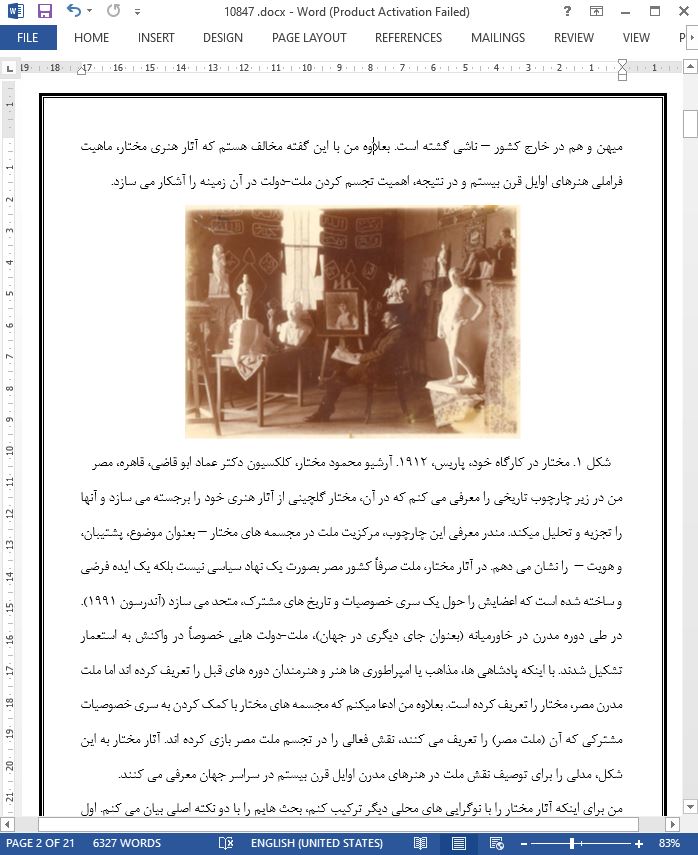
In a 1912 photograph, the young Egyptian sculptor Mahmoud Mukhtar (1891–1934)1 relaxes in his Paris studio, surrounded by French-style academic sculptures and calligraphic wall-hangings in Arabic (Figure 1). On the right stands a verisimilar sculpture of a nude man in contrapposto pose, and in the upper left appears the creed of the Muslim faith – ‘There is no god but God and Muhammad is his prophet’ – sewn in white wobbly script on a dark background. Mukhtar sits and sketches tranquilly amid these seemingly contradictory visual traditions. This is not a casual snapshot: the artist consciously positioned himself and his studio to represent his grounding in both Arabo-Islamic culture and European fine arts. In this paper, I investigate how and why Mukhtar made the transition from Islamic references early in his career to a style known as Pharaonism, which instead looked to ancient Egyptian imagery. I argue that this shift resulted from Mukhtar’s participation in imagining the modern nation-state of Egypt, both at home and abroad. Moreover, I contend that Mukhtar’s artwork reveals the transnational nature of the early twentieth-century art world and the consequential importance of visualizing nation-states within that context.