Abstract
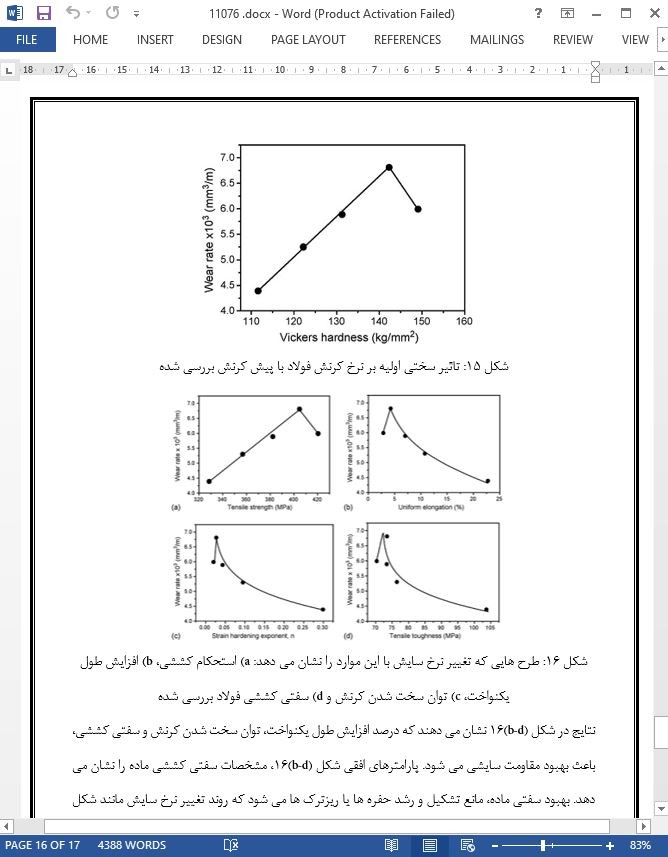
Dry sliding wear behaviour of a plain carbon steel in different pre-strained conditions was examined in the severe wear regime using a pin-on-disk wear testing machine. The severe wear regime was ascertained by determining wear rates of the unstrained material at different loads. The primary experiments were supplemented by microstructural characterization, hardness assessment of specimens before and after wear tests, determination of tensile properties of the pre-strained specimens and SEM examination of the worn-out surfaces and subsurfaces. The results indicate that the wear rate of the specimens first increases up to 15% pre-strain and then decreases, while the hardness and tensile strength of the specimens monotonically increases with increased pre-strain. The mechanism of wear is observed to be subsurface cracking and delamination aided by oxidative wear. The imposed pre-strain on a specimen is considered to aggravate the nucleation of voids and microcracks resulting in degradation of wear resistance of the pre-strained specimens. The results infer that wear rates of pre-strained materials are governed by ductility or toughness apart from hardness and strength.
1. Introduction
Structural components are often directly put into service in cold deformed condition. Cold deformation is essentially a pre-straining process, which alters dislocation substructure of metallic materials, and in turn, their deformation behaviour. There exist scattered attempts to understand structure–property relationships of cold deformed materials with emphasis on properties like strength [1,2], hardness [3], fatigue [4] and fracture [5,6]. However, till date, no organized attempt has been made to understand wear behaviour of materials in the pre-strained or cold deformed condition. It is well known that sliding wear is controlled by abrasion, adhesion and delamination [7]. The process of delamination is caused by the nucleation of voids or microcracks in a severely strained material with subsequent propagation of the cracks parallel to the surface [8]. Terheci [9] reported the existence of two mechanisms for void initiation during delamination. These are: (i) twin dislocation mechanism and (ii) void formation around hard inclusions [9]. Since both these mechanisms are governed by dislocation substructures, it is expected that pre-straining of a material will have a considerable influence on sliding wear behaviour of materials. The content of this paper is aimed to reveal the nature of such influence on the wear resistance of 0.15% carbon steel.
4. Conclusions
The major conclusions derived from the results of this investigation are:
1. The wear rates of the 0.15%C steel increase with increased initial pre-strain up to 15%.
2. Hardness and tensile strength of the steel increase monotonically with increasing pre-strain as per expectation. An improvement in these properties generally leads to achieving improved wear resistance of the pre-strained specimens. The results obtained are contrary to this expectation.
3. The phenomena of the ease of nucleation of voids and microcracks, and their subsequent rapid propagation are attributed to be the dominant governing factors for the deterioration of wear resistance of pre-strained (for pre-strain ≤ 15%) materials.
4. The overall process of wear in pre-strained specimens is governed by: (i) the ease of nucleation of voids or microcracks, which causes delamination, and (ii) oxidative wear. The drop in wear rate for specimens possessing higher pre-strain of 20% is attributed to the competitive pre-dominance of these wear processes.