Abstract
The development of 5G terrestrial mobile communications technology has been a driving force for revolutionizing satellite mobile communications. Satellite mobile communications, which carry many unique features, such as large coverage and support for reliable emergency communications, should satisfy the requirements for convergence between terrestrial mobile communications and satellite mobile communications for future broadband hybrid S-T communications. On the other hand, CR is an attractive technique to support dynamic single-user or multi-user access in hybrid S-T communications. This article first discusses several key issues in applying cognitive radio to future broadband satellite communications toward 5G. Then we present an overview of future broadband hybrid S-T communications systems, followed by an introduction to a typical application scenario of futuristic CR-broadband hybrid S-T communication systems toward 5G. Moreover, we propose a space segment design based on a spectrum-sensing-based cooperative framework, in consideration of the presence of MUs. An experiment platform for the proposed CR-based hybrid S-T communications system is also demonstrated.
Introduction
Terrestrial mobile communications technology has undergone a rapid growth in the past 20 years. In these decades, modern terrestrial mobile communications have been evolved from the first generation (1G), which is analog systems, to 4G, which supports broadband mobile communications. Currently, 4G systems have been widely deployed by telecommunications operators all over the world. At present, the planning and standardization efforts for 5G mobile systems are underway. The Third Generation Partnership Project (3GPP), IEEE, International Mobile Telecommunications (IMT), and many other standardization bodies are working together with manufacturers and telecom operators in an effort to standardize 5G mobile communications systems. Meanwhile, the International Telecommunication Union (ITU) has started to call for 5G proposals. New proposals need to satisfy the requirements of high spectrum utilization and energy efficiency. The data rate of 5G will also need to be much higher than that of 4G.
Conclusion
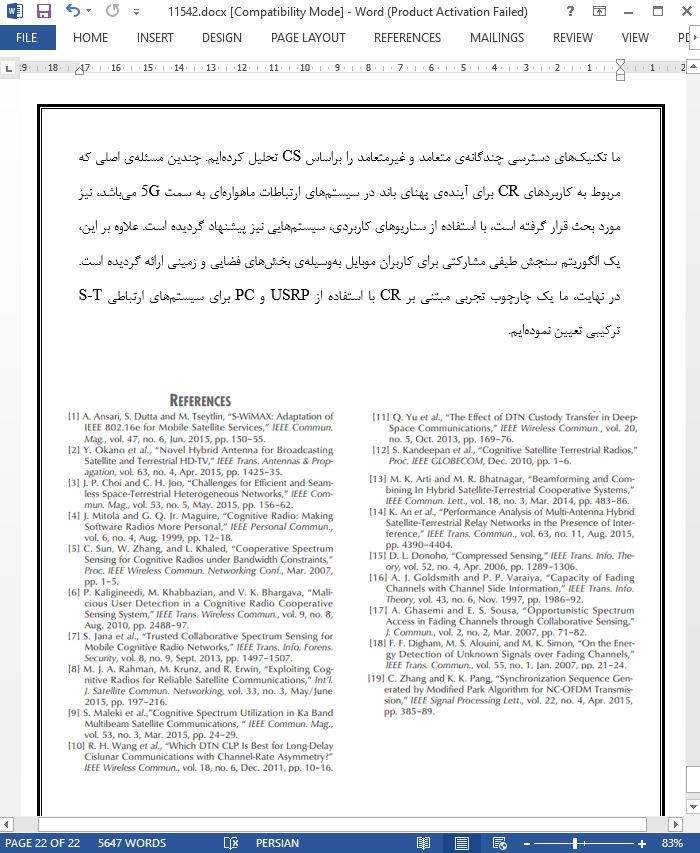
Broadband hybrid S-T communications systems composed of terrestrial and space segments can satisfy the requirements of a large number of users with diversified services in future 5G networks. In this article, we present an overview on the fundamentals of future broadband hybrid S-T communications systems using three GEO satellites, and propose a hierarchical structure of the space network based on the experiences in China. We analyze both orthogonal and non-orthogonal multiple access techniques based on CS. Several key issues related to the applications of CR to future broadband satellite communication systems toward 5G are also discussed, along with the application scenarios of the proposed systems. Moreover, we propose a cooperative spectrum sensing algorithm for mobile users of the terrestrial and space segments. Finally, we demonstrate a CR-based experimental platform using USRP and PC for hybrid S-T communication systems.