Abstract
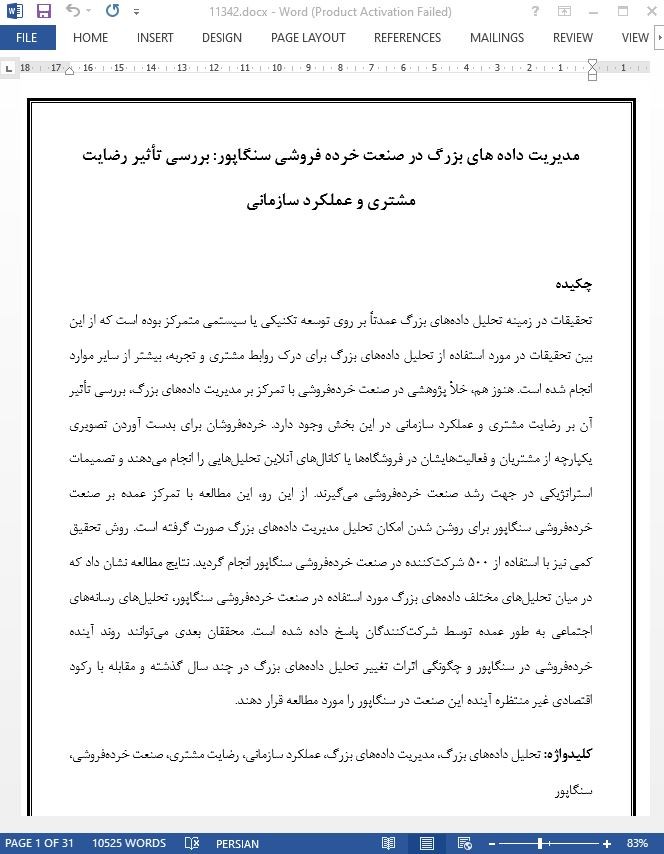
Much of the research on big data analytics has been centered on technical or system development. Research has been carried out on the usage of big data analytics to understand customer relationships and experience, amongst others. Still, there is a lack of research in the retail industry considering big data management, examining the impact on customer satisfaction and organizational performance in the retail sector. Retailers explore analytics to gain a unified picture of their customers and operations across the store or online channels and make strategic decisions contributing to the growth of the retail industry. Thereof, this study has been conducted by majorly focusing on the Singapore retail industry to clarify the feasibility of big data management analytics. Quantitative research method was employed involving 500 participants from the retail industry of Singapore. The results of the study stated that amongst the different big data analytics utilized within the retail industry of Singapore, social media analytics had been majorly answered by the participants. Future researchers can study about the upcoming retail trends in Singapore and how the effects of big data analysis changed in the past few years and deal with the unexpected future recessions in the retail industry within Singapore.
1. Introduction
Several organizations suffer to maintain large sets of data and the related nontraditional data structures. Different factors of expanding data management skills of an organization and enhancing the portfolios in terms of data management software are also implemented for big data management. Such measures help in increasingly automating the operations of the organization, and the outcome of such processes is the big data management (BDM). The big data should be permanently placed within the data management system of organizations (Russom, 2011). The ability to access, analyze, and manage enormous data volumes besides the fast evolution of information architecture is increasingly critical for retailers who intend to improve business and performance efficiency. Although the key to success is suitable customer experience, operational efficiency, loyalty, and customer retention, the demand of anticipation is significant for the proficient management of inventory, cash, and overall profitability. While retailers grow and extend in the diverse market, the data type that is commonly managed has become more complex. However, the analysis of such complex data leads to a comprehensive understanding of the product’s path to profitability (Ernst and Young, 2014).
5. Conclusions
The impact of big data on the organization’s performance involves an increase in higher sales, as per the results of the conducted study. The reduced cost had also been indicated, but more responses had been in favor of a higher number of sales. In the case of the impact on customer service, highly satisfied customers had been observed. This had been further supported by the literature studies, as different studies had also depicted the same results in this context. The study had further described “Fork in the Road” strategy as an essential approach utilized for managing big data and VLDB paradigm as the main methodology to be used. In terms of reducing barriers within the aspect of big data management, the course of hiring skilled resources within various analytics had been selected by most of the participants. In addition, for the platform of possible competencies, mass customization or customization marketing had been depicted.