Abstract
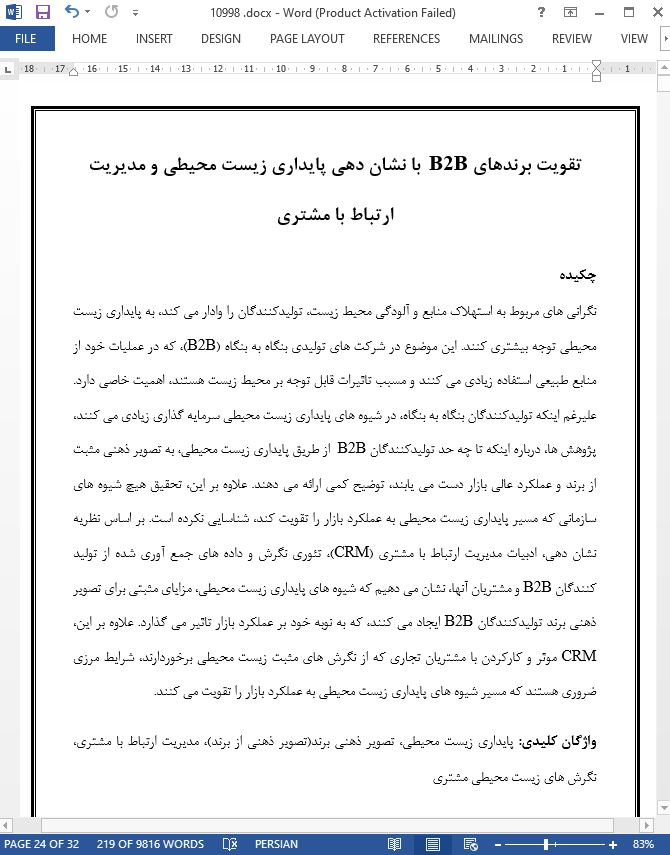
Resource depletion and environmental pollution concerns are forcing manufacturers to pay greater attention to environmental sustainability. This is especially so for business-to-business (B2B) manufacturing firms who intensively use natural resources in their operations and are blamed for observable impacts on the environment. Despite investments in environmental sustainability practices by B2B manufacturers, studies provide little explanation about the extent B2B manufacturers obtain a positive brand image and superior market performance through environmental sustainability. Furthermore, research has not identified organisational practices that strengthen the path from environmental sustainability to market performance. Drawing on signalling theory, the customer relationship management (CRM) literature, attitude theory, and data collected from B2B manufacturers and their customers, we show that environmental sustainability practices provide positive benefits to B2B manufacturers' brand image, which, in turn, impacts market performance. Further, effective CRM and working with business customers with positive environmental attitudes are essential boundary conditions that strengthen the path from environmental sustainability practices to market performance.
1. Introduction
Increasing pollution and consumption of resources by businesses, along with pressures from climate change have fuelled concerns about addressing environmental challenges (Albino, Dangelico, & Pontrandolfo, 2012; Gupta, Czinkota, & Melewar, 2013). These challenges, along with the greater emphasis on addressing environmental issues by governmental and environmental protection agencies, are forcing manufacturers to adopt environmental sustainability practices in their operations (Esfahbodi, Zhang, & Watson, 2016). Environmental sustainability when viewed from a business perspective concerns pollution prevention, waste minimisation, and reduction of energy and raw material consumption, aimed at diminishing the detrimental consequences of firms' activities on the environment (Antolín-López, Delgado-Ceballos, & Montiel, 2016; Gupta & Kumar, 2013). An important benefit for manufacturers in adopting environmental sustainability practices is being noted for sustainability among customers concerned about the environment (Kumar & Christodoulopoulou, 2014; Sharma, Iyer, Mehrotra, & Krishnan, 2010).
5. Discussion and implications
Manufacturers are now under mounting pressure to invest in environmental sustainability practices to protect the environment and use resources more efficiently (Esfahbodi et al., 2016). The literature supports the view that B2B customers are placing greater emphasis on purchasing from brands that show higher concern for environmental sustainability (Kumar & Christodoulopoulou, 2014; Sharma et al., 2010). However, the literature is silent on the extent that investment in environmental sustainability benefits B2B firms to strengthen their intangible marketing assets, especially brand as a major marketing asset. This study identifies the extent to which B2B manufacturing firms pursuing environmental sustainability improves their brand image and market performance. Given our focus on environmental sustainability, brand image, and market performance, we also examined the contingency roles of CRM and business customers' environmental attitudes. Our theoretical framework is validated through our methodology, which includes the perspectives of multiple stakeholders (i.e., B2B manufacturing firms [multiple business unit managers] and their business customers) from different manufacturing industries. Our findings offer several theoretical and managerial implications.