Abstract
Purpose The purpose of this paper is to focus on the personality characteristics of mentors.
Design/methodology/approach The five factor model of personality was used to examine relationships between personality and participation as a mentor. A sample of 194 practicing veterinarians were surveyed on the five factor model of personality and a scale assessing their participation as a mentor across junior professionals, interns and high school students.
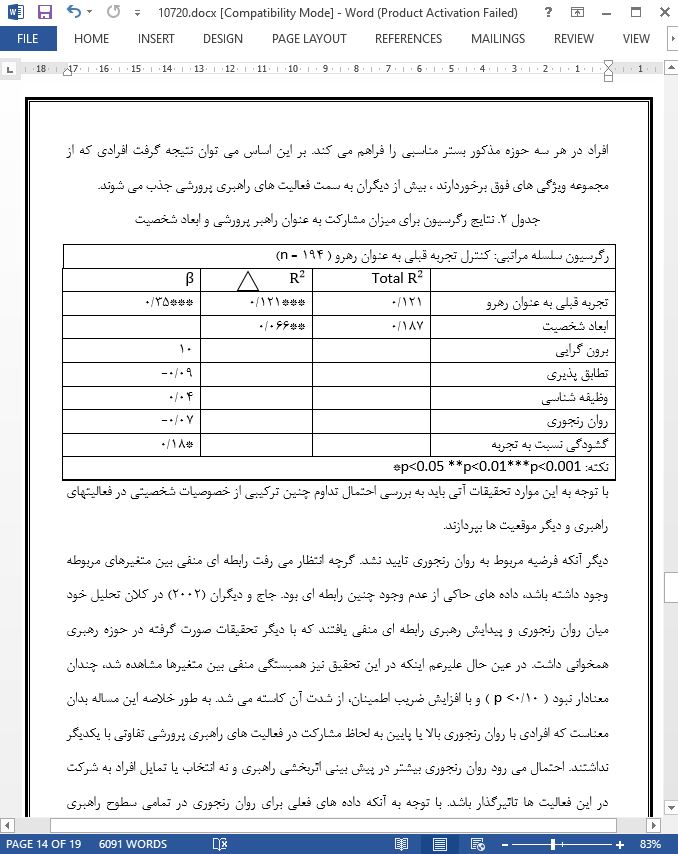
Findings Results indicated that extroversion, conscientiousness, and openness to experience were positively correlated with participation as a mentor. Personality traits also explained significant variance in participation as a mentor after controlling for prior experience with a mentor. These results suggest that participation as a mentor could be influenced to some degree by personality. Mentoring involves active engagement in an environment requiring social, task, and idea‐related capabilities, thus individuals who are extroverted, conscientious, and open to experience would likely feel more comfortable.
Research implications/limitations The study was only a survey study with data gathered from a single source, so any causal inferences are limited.
Practical implications If individuals volunteer for mentoring based primarily on personality tendencies, then it is possible that many talented employees would not be attracted to a mentoring situation due to their personalities. In order to have the best mentors, organizations might have to develop mechanisms to attract, select, motivate, and train talented employees to volunteer for and remain in such service.
Originality/value Relatively little research has focused on the personality characteristics of mentors.
Research supports mentoring as an effective means for enhancing work outcomes and career development (Allen et al., 2004; Kram, 1985). Mentoring programs have been initiated across a wide range of business and professional fields, including accounting (Weinstein and Schuele, 2003), healthcare (Perrone, 2003), public administration (Milam, 2003), and veterinary medicine (Walsh et al., 2003). While the value and quality of mentoring depends partly on the quality of the mentors, little research has focused on the characteristics of the mentors (Allen, 2003; Allen et al., 1997a, b). The existing research has examined three levels of individual characteristics of mentors – demographic, experiential, and personality – and their influence on the willingness to be a mentor (Allen et al., 1997b). Demographic factors such as age, gender, and educational level, as well as prior experience as a mentor or prote´ge´, have been found to be related to the willingness to mentor (Allen et al., 1997b; Olian et al., 1993; Ragins and Cotton, 1993). Only a few studies have examined personality predictors of the willingness to mentor. Allen and her colleagues (Allen, 2003; Allen et al., 1997a) found that a prosocial personality predicted the willingness to mentor others, while other researchers supported locus of control (Allen et al., 1997b; Turban and Dougherty, 1994) and upward striving (Allen et al., 1997b; Hunt and Michael, 1983) as personality-based motivators of mentoring activity.
Limitations of the study
The cross-sectional nature of the survey study prevents drawing conclusions as to the causal priorities among the variables. As with most personality research, it is not clear whether extroverted, conscientious, and adaptable individuals participate in mentoring roles because of their traits or if the traits emerged after service as a mentor. The present study did not examine reasons why the individuals participated as mentors, only seeking correlations between their participation and personalities. The respondents in the study provided all data, thus the results must be tempered with the possibility of single source bias.