Abstract
In-plane soil-structure-interaction of a shear wall on a rigid circular foundation embedded in a linear elastic half-space, excited by an incident plane SV wave, is solved by relaxing the zero-stress boundary conditions on the ground surface. An approximate solution of this model was previously presented for the cylindrical approximation of the ground surface. This paper formally neglects such boundary conditions, and as a result, the complexity of the formulation is significantly reduced. Solutions for foundation and building motions in frequency space are compared to the previous results and it is shown that the present approximate solution provides excellent and almost identical results. The objective of this paper is to provide further insight on the role and the effects of surface boundary conditions for this type of problem.
1. Introduction
The study of soil-structure interaction (SSI) during seismic excitation by means of elementary models is an area that attracts continuing interest in earthquake engineering. In addition to solving such problems by numerical simulations such as finite elements, finite differences, and boundary integral methods, analytic approaches based on wave-function expansion have also shown to be successful in cases of simple foundation and building geometries. In addition to ease of computation, closed-form solutions help explore the underlying physics of the problem and serve as a reference to check the accuracy of numerical simulations. Among two-dimensional problems, cases of an incident plane SH wave was solved earliest by the method of images [1,2], which helps to satisfy the boundary condition on the ground surface through setting up wave functions that form the mirror symmetry with respect to this boundary. However, the image method does not work in cases of incident plane P or SV waves because of the coupled boundary conditions and the mode conversion between the two. As such, approximate analytic solutions based on the large circular approximation (LCA) – i.e. treating the ground surface as a surface of a large cylinder – has been the main early approach for analyzing in-plane motions.
5. Summary
This paper presents results based on an approximate analytic procedure for solving the 2-dimensional, soil-structure-interaction problem excited by an incident plane SV wave. The approximation is based on relaxing the zero-stress boundary conditions on the half-space surface. It is shown that under such conditions, the wave function expansion becomes simple, and only half of the series representation for the scattered waves is required. Also, the closed-form solution depends only on finite-dimensional matrices and is easy to compute.
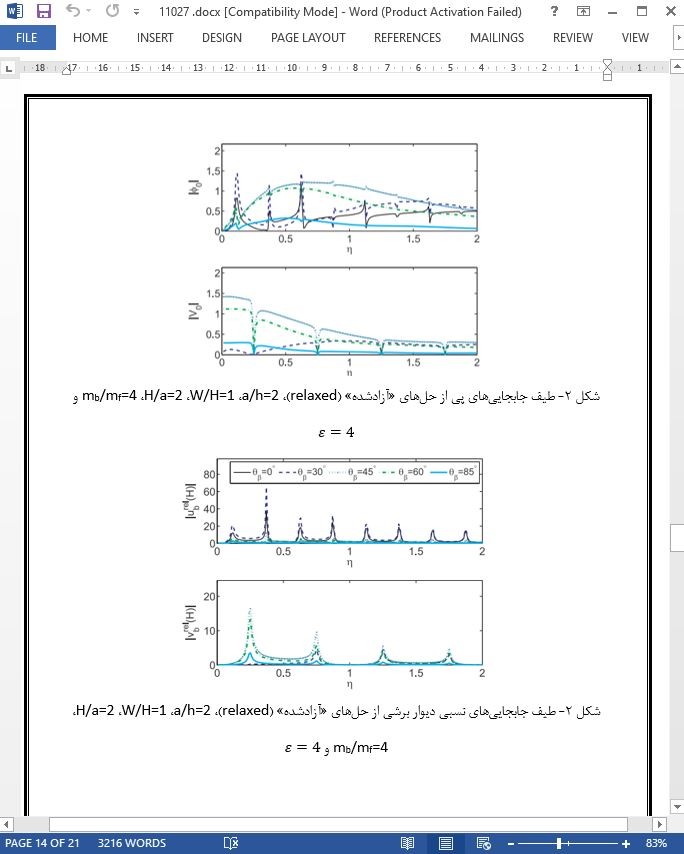
For cases of semi-circular foundation and shallow foundation when the incidence is below critical, numerical results on foundation displacements and shear wall responses agree well with those of [3]. For cases of shallow foundation when incident angles are beyond critical, numerical results are presented here for the first time. The agreement between the cases presented in this paper and those in [3] suggest that the free-surface boundary conditions are indeed not as essential as other conditions that govern the solution (the continuity of displacements along the contact surface between the half-space and foundation, and the dynamic equilibrium of the foundation). This result also supports the results of [7], which suggests that the solution to the model obtained from relaxed surface conditions may be similar to the solution in which a cylindrical approximation of the ground surface is made.