Abstract
While much research has been undertaken to examine how technology impacts individuals and groups in organizations, as well as how it impacts organizations in their entirety, attention has not been directed at how technology impacts the relationships between these different levels in an organization— individual, group, and organization-wide. This paper seeks to address this void. Specifically, a grounded theory approach is used to begin development of a theory for how technology impacts these relationships. Based on a semi-structured survey, the resultant model is presented. Eight technology variables are identified in the model as responsible for impacting the relationships between the different levels of an organization. As a first foray into this area, the findings in this paper can serve as the foundation for further theory development and empirical testing.
The impact of technological innovation on organizational performance has been of interest to researchers since Trist and Bamforth’s [42] studies in British coal mines led to the development of sociotechnical theory. In the subsequent half-century, many researchers have studied the interaction of social and technical aspects of organizations and the effects of such interactions on organizational performance. Research has emphasized individual, group or organizational behavior, and it has recognized the ability of technology to assist in reengineering work patterns, building electronic coalitions internally and externally, and disseminating information throughout the organization. However, there has been little or no work on how technological innovation impacts the relationships among levels in an organization specifically among individuals, groups, and the organization itself. Further, the constant evolution of technology suggests that the impacts of technology will continue to transform organizations in new and profound ways that have yet to be identified [28].
In studying the role of technology on organizational performance, classical theory provides an interesting starting point. Because of the rapid and potent nature of technological advancement, the possibility of uprooting long-held beliefs about organizations exists. Child and Faulkner [5] show technology influences organizational alliances, power within an organization, and the development of virtual organizations. Moreover, Katz and Kahn [22] suggest that technology may inhibit individual autonomy, which counters the 1960s movement emphasizing small group activity [6]. Rice and Bair [33] argue that electronic communication media enhance organizational productivity. Clearly, these far reaching impacts of technology indicate the potential for technology to alter classically held beliefs about organizations. Pursuant to challenging classical theory, how technology is influencing the relationship between (a) individuals and the organization in its entirety and (b) individuals and the groups to which they belong can be studied within the context of newly developed theories (or within the context of reinforced classical notions should the research show that classical theory is upheld).
5. Conclusions and future directions
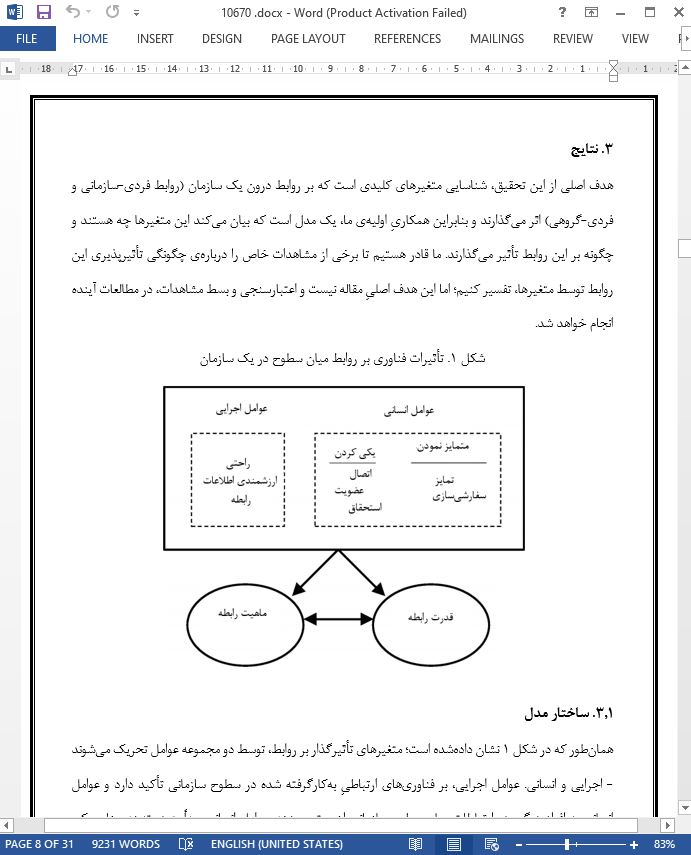
The model presented in this paper serves as a first step toward understanding the key factors that impact the relationships between the various levels within an organization. Businesses should consider our observations when evaluating an IT investment intended to enhance either the relationship between individuals in the organization and groups to which they belong or the relationship between individuals and the organization itself. We have shown that technologies should be convenient and easy to use, develop a sense of fairness and equity among peers, and engender both a sense of membership and connection to the organization. Some negative effects to the individual-organization relationship appear as a result of the impersonal nature of technology, but overall the positives outweigh the negatives, and communication that is more personal (e.g., faceto-face, telephone), possesses its own set of shortcomings, particularly inconvenience, inequity, and exclusion. The negative effect of impersonal technologies is less pronounced in the individual-group relationship.