Abstract
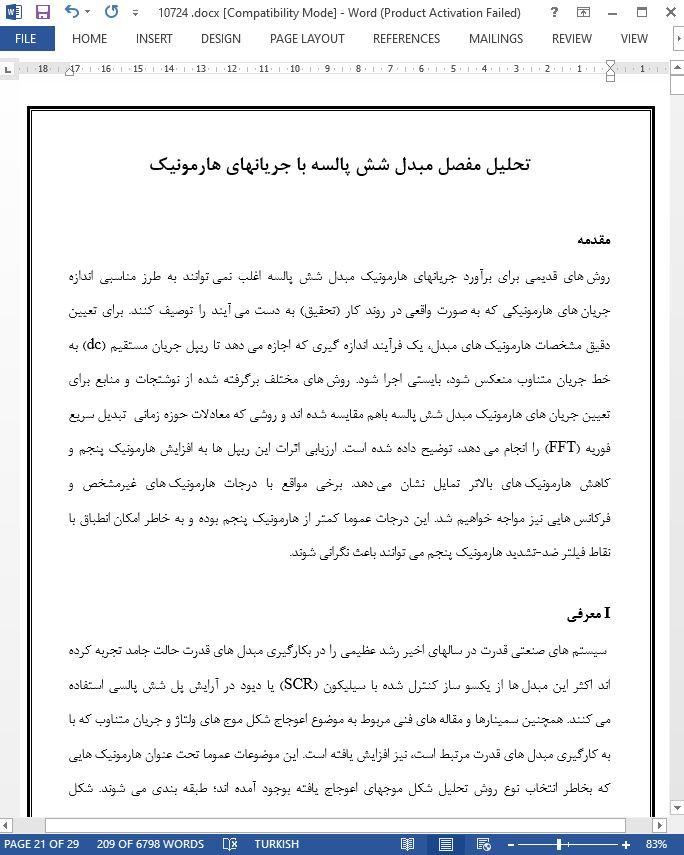
Classical methods for the determination of six-pulse converter harmonic currents often do not adequately describe the harmonic current magnitudes actually found in practice. To accurately determine the magnitude of characteristic converter harmonics, a calculation procedure which takes into account the ripple of the dc current reflected back into the ac line current must be performed. Various methods from the literature for the determination of six-pulse converter harmonic currents are compared and a method which takes the Fast Fourier Transform of the time domain equations is described. Evaluation of these ripple effects tends to increase the magnitude of the 5th harmonic while decreasing the magnitudes of higher order harmonics. Noncharacteristic harmonic orders or frequencies will sometimes also be encountered. These orders typically will be less than the 5th and can be of concern because of possible coincidence with 5th harmonic filter anti-resonance points.
I. INTRODUCTION
INDUSTRIAL power systems in recent years have experi- I enced a tremendous growth in the application of solid-state power converters. Most of these converters utilize SCR’s or diodes in a six-pulse bridge configuration. There has also been a proliferation of technical papers and seminars dealing with the ac current and voltage waveform distortion issues .associated with the application of power converters. These issues have commonly been classified as the subject of harmonics due to the method of analysis of these distorted waveforms. Any distorted, periodic waveform can be segregated into a fundamental sinusoidal waveform plus a series of sinusoidal waveforms that have frequencies that are integral multiples of the fundamental. These integral multiple waveforms are harmortics of the fundamental quantity which can be a voltage or current. XI.
CONCLUSION
The assumption of l/h per unit harmonics, even when modified to allow for the attenuating effects of commutation, will not adequately describe the actual magnitude of six-pulse converter harmonic currents in many cases. To accurately determine the magnitude of characteristic converter harmonics, a calculation procedure which takes into account the ripple of the dc current reflected back into the ac line current must be performed. Evaluation of these ripple effects will tend to increase the magnitude of the 5th harmonic while decreasing the magnitude of the higher order characteristic harmonics. The FFT method described in this paper and implemented in computer software will accurately predict converter harmonic currents across a range of firing angles, commutating reactance and dc link inductance values. The classical, Dobinson or Graham-Schonholzer methods can be implemented by hand calculation but the limitations of each must be considered or large errors in the results may occur.
Non-characteristic harmonic orders or frequencies will sometimes also be encountered. These orders typically will be lesdthan the 5th and can be of concern because of possible concidence with 5th harmonic filter anti-resonance points.