Abstract
Schema matching is a crucial step in data integration. Many approaches to schema matching have been proposed so far. Different types of information about schemas, including structures, linguistic features and data types, etc have been used to match attributes between schemas. Relying on a single aspect of information about schemas for schema matching is not sufficient. Approaches have been proposed to combine multiple matchers taking into account different aspects of information about schemas. Weights are usually assigned to individual matchers so that their match results can be combined taking into account their different levels of importance. However, these weights have to be manually generated and are domain-dependent. We propose a new approach to combining multiple matchers using the Dempster-Shafer theory of evidence, which finds the top-k attribute correspondences of each source attribute from the target schema. We then make use of some heuristics to resolve any conflicts between the attribute correspondences of different source attributes. Our experimental results show that our approach is highly effective.
1 Introduction
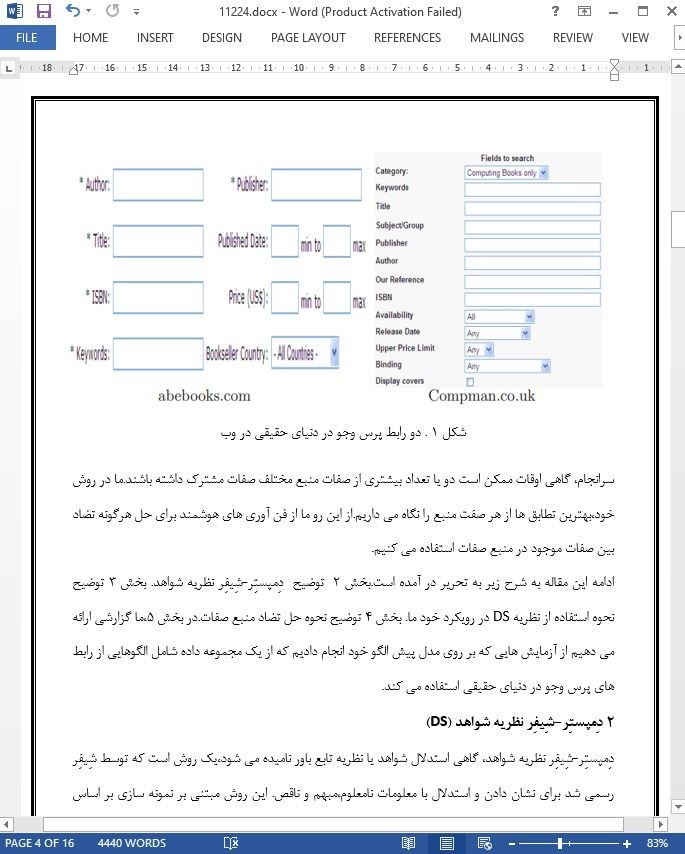
There are now many searchable databases on the Web. These databases are accessed through queries formulated on their query interfaces only which are usually query forms. The query results from these databases are dynamically generated Web pages in response to form-based queries. The number of such dynamically generated Web pages is estimated around 500 times the number of static Web pages on the surface Web [1]. In many domains, users are interested in obtaining information from multiple sources. Thus, they have to access different Web databases individually via their query interfaces. For large-scale data integration over the Deep Web, it is not practical to manually model and integrate these Web databases. We aim to provide a uniform query interface that allows users to have uniform access to multiple sources [2]. Users can submit their queries to the uniform query interface and be responded with a set of combined results from multiple sources automatically.
7 Conclusions and Future Work
In this paper we proposed a new approach to combining multiple matchers by using the Dempster-Shafer theory of evidence and presented an algorithm for resolving the conflicts among the correspondences of different source attributes. In our approach, different matches are viewed as different sources of evidence, and mass distributions are defined on the basis of the match results from these matchers. We use Dempster’s combination rule to combine these mass dustributions, and choose the top k correspondences of each source attribute. Conflicts between the correspondences of different source attributes are finally resolved. We have implemented a prototype and tested it using a large dataset that contains real-world query interfaces in five different domains. The experimental results demonstrate the feasibility and accuracy of our approach.