Abstract
The presence of residual stress in members can significantly compromise the stiffness and fatigue life of steel structural components. Researches in this area are well documented for structural members of mild carbon steels. Nevertheless, due to the difference of stress–strain relations and material properties under ambient and high temperatures, the residual stress distribution in a high strength steel member is physically different from those fabricated from mild carbon steel. It is imperative to study the residual stress distribution for structural members fabricated from high strength steel. In this paper, the residual stresses of three welded flame-cut H-section columns with a nominal yield strength of 460 MPa but different cross-section dimensions were investigated. Both sectioning and hole-drilling methods were used in the measurement and the obtained residual stresses were compared between the two methods. The magnitudes and distributions of the measured residual stresses are identical with those of carbon steel, however in relatively smaller residual stress ratios. Finally, based on the measurements, a simplified residual stress distribution for 460 MPa high strength steel members with welded flame-cut H-section is proposed.
1. Introduction
Welded, hot-rolled, flame-cut or flame-straightened structural components are usually not initially stress free. Residual stresses exist in these structural steel members induced by the non-uniform temperature distributions during the manufacture, fabrication or refinement processes. Owing to the sufficiently high ductility of steel material, residual stresses are often not detrimental to the plastic strength of cross sections, but the presence of residual stress may significantly impair the stiffness of compression members and shorten the fatigue life of steel members under periodical load or dynamic load. In order to investigate the effect of residual stresses, the magnitudes and distributions of residual stresses in welded mild carbon steel sections have been extensively investigated [1,2]. Since the stress–strain curves and high-temperature material properties [3] of high strength steel (HSS, yield strength≥460 MPa) are different from the regular strength steel, it is expected that the residual stresses in HSS sections are different from those in mild carbon steel sections.
6. Conclusion
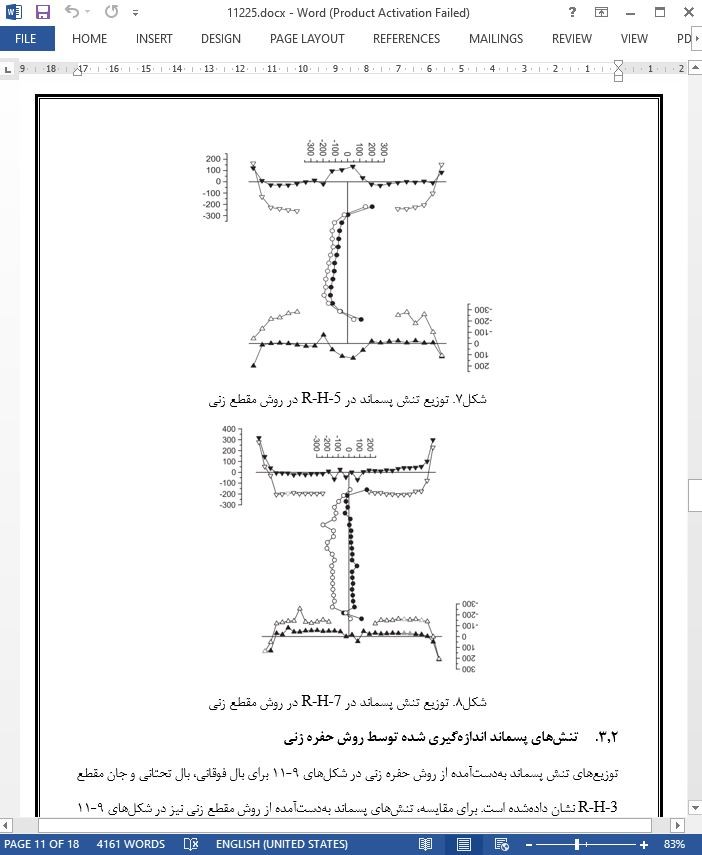
The residual stress distributions of three different H-sections fabricated from flame-cut Q460 high strength steel plates were presented. The simplified residual stress distributions were proposed. The average compressive residual stresses σrc in flanges were −19.5%, −27.1% and −40.8% of yield strength according to the width to thickness ratios of outstanding flanges, which were 7.1, 5.0 and 3.4 respectively. The average calculated tensile residual stresses σrt in each section were 73.1%, 90.0% and 103.9% of yield strength for specimens R-H-7, R-H-5 and R-H-3, respectively. The test results obtained by both sectioning and hole-drilling methods were compared. It is observed that the average values of compressive residual stress obtained by the two methods are similar, but the residual stress distributions obtained by sectioning method is more convenient to be employed in the numerical analysis. By comparing the measured specimens, it is found that the increase in width to thickness ratios of an outstanding flange will result in decreasing of compressive residual stresses within flanges and increasing of tensile residual stresses at flange tips. The comparison of the test result with those of mild carbon steel shows that the residual stress ratios of HSS flame-cut welded H-sections tend to be less detrimental to the column strength than the ordinary steel H-sections.