Abstract
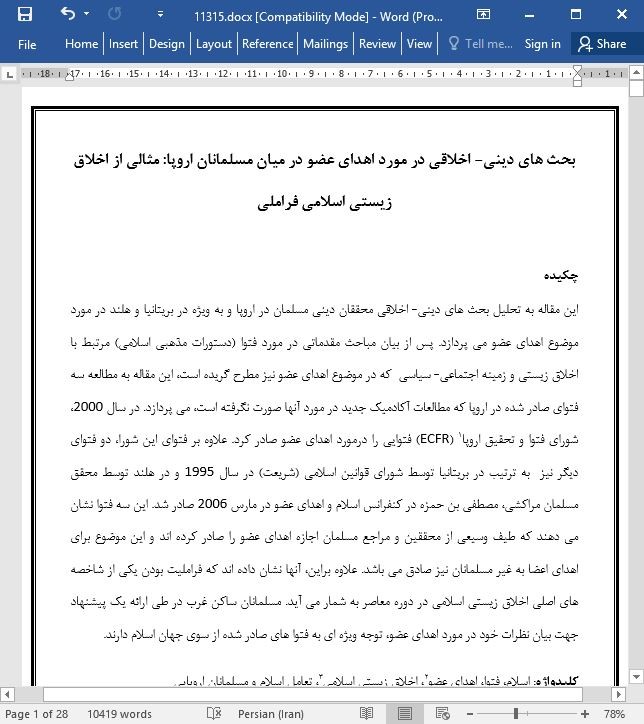
This article analyzes the religio-ethical discussions of Muslim religious scholars, which took place in Europe specifically in the UK and the Netherlands, on organ donation. After introductory notes on fatwas (Islamic religious guidelines) relevant to biomedical ethics and the socio-political context in which discussions on organ donation took place, the article studies three specific fatwas issued in Europe whose analysis has escaped the attention of modern academic researchers. In 2000 the European Council for Fatwa and Research (ECFR) issued a fatwa on organ donation. Besides this “European” fatwa, two other fatwas were issued respectively in the UK by the Muslim Law (Shariah) Council in 1995 and in the Netherlands by the Moroccan religious scholar Mus˙ t ˙ afa¯ Ben H˙ amza during a conference on “Islam and Organ Donation” held in March 2006. The three fatwas show that a great number of Muslim religious scholars permit organ donation and this holds true for donating organs to non-Muslims as well. Further, they demonstrate that transnationalism is one of the main characteristics of contemporary Islamic bioethics. In a bid to develop their own standpoints towards organ donation, Muslims living in the West rely heavily on fatwas imported from the Muslim world.
Introductory Notes
Three main fatwas issued in Europe between 1995 and 2006 on organ donation will be analyzed in this article. Attention will be paid to the Islamic religio-ethical arguments adopted in each fatwa. Another focal point in this analysis is the transnational dimension in these fatwas: to what extent do these fatwas cross the national borders of Europe to quote or base their arguments on fatwas imported from the Muslim world? Bearing in mind the fact that a fatwa is in principle an answer to a question raised by an individual or community and thus reflects specific social concerns, attention will also be paid to the dissemination of these fatwas and their reception by the Muslim community to whom the fatwa is directed. Before delving into the analysis of these three fatwas, first two introductory remarks are due:
Conclusions
This article analyzed three main fatwas issued respectively in 1995 by the Muslim Law (Shariah) Council UK, in 2000 by the European Council for Fatwa and Research (ECFR) and finally in 2006 by the Moroccan religious scholar Mus˙ t ˙ afa¯ Ben H˙ amza during a conference held in the Netherlands. On the basis of these three fatwas, three main conclusions can be reached.
First of all, the three fatwas agree that both life and cadaveric organ donations are in principle permitted in Islam. None of the fatwas stated that this standpoint would change if the recipient or the donor was a non-Muslim. The fatwa of Ben H˙ amza clearly argued for the permissibility of donating organs to non-Muslims and stated that receiving organs donated by non-Muslims on one hand and refusing to donate organs to them on the other hand is neither ethical nor Islamic.