Abstract
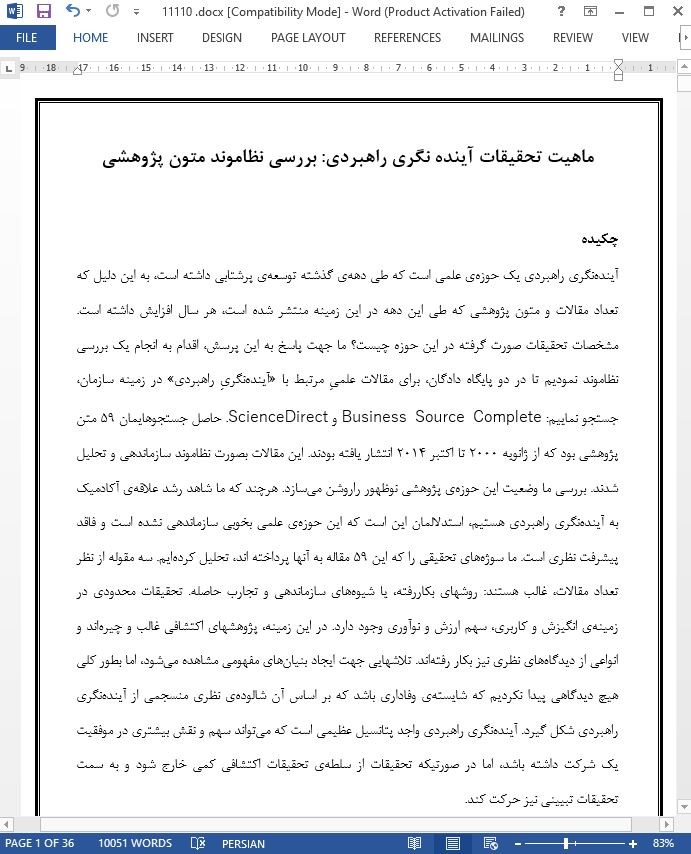
Strategic foresight is a scientific field in rapid development judged from the increase in number of yearly publications the last decade. What characterizes the research in this field? To answer this question we undertook a systematic literature review searching two library databases, Business Source Complete and ScienceDirect, for scientific articles related to the topic ´strategic foresight´ in the context of the organization. The search revealed 59 publications published between January 2000 and October 2014. The articles were systematically organized and analyzed. This review provides the status of this emergent research field. Although we witness a growth of academic interest in strategic foresight, we argue that this scientific field is weakly organized and there is a lack of theoretical progress. We have analyzed the research subjects addressed in the 59 articles, and from this a taxonomy of eight categories. Three categories dominate in terms of frequency of articles: methods applied, organizing practices, and experiences gained. There is only limited research on motivation and use, value contribution, and innovation. Explorative research dominates, and a variety of theoretical perspectives has been used. Some attempts to build conceptual foundations can be observed, but in general, we found no single perspective that deserves loyalty on which a coherent theoretical foundation of strategic foresight is built. Strategic foresight has a great potential of contributing more to the success of a firm if the research moves from today's dominating explorative research to also include more explanatory research.
1. Introduction
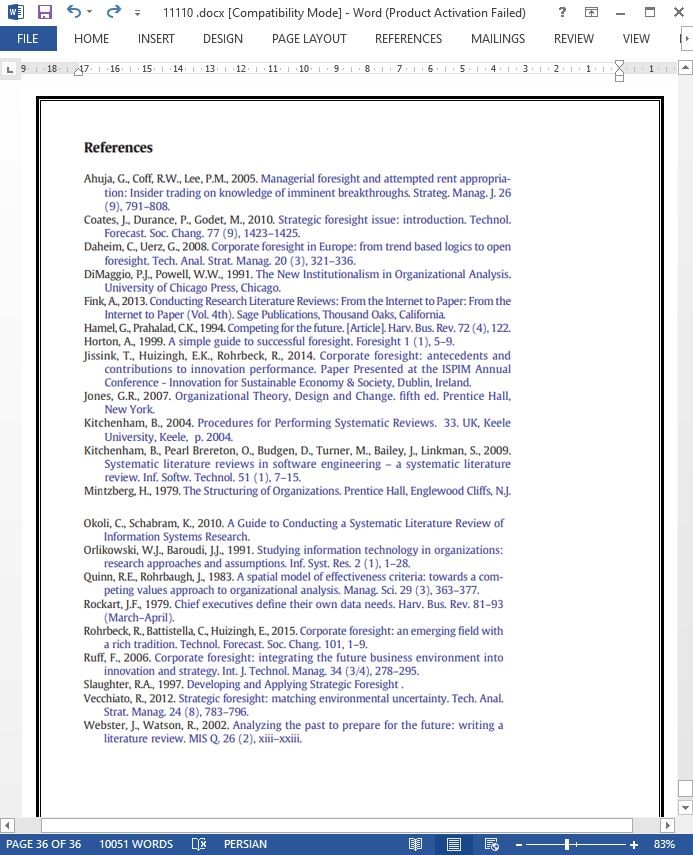
This article reviews existing research on the use of strategic foresight in firms. Strategic foresight involves understanding the future and applying future oriented insights to an organization's strategic activities and decision making. Rohrbeck et al. (2015) gives an historical background of the foresight research field, from its birth in the 1950s through scenario building in the 1960s–1970s, to organizational integration from 2000 to present. Different terms have been used to relate foresight thinking to strategic decision making in corporations. Hamel and Prahalad (1994) define industry foresight to be deep insights into trends that can be used to create new competitive space. Slaughter (1997) uses the term strategic foresight to represent a fusion of futures methods with those of strategic management. Ahuja et al. (2005) use foresight as a personal power of foreseeing. They define managerial foresight as the ability to predict how managers' actions can create competitive advantage. Rohrbeck et al. (2015) use the term corporate foresight as a practice that permits an organization to lay the foundation for a future competitive advantage through value creation.
5. Conclusion
Strategic foresight is a systematic approach to learning and understanding possible futures and building shared visions and is aimed at guiding and enabling present-day decisions. It is “… understood as the processes that assist decision makers in charting the firm's future course of action” (Vecchiato, 2012).
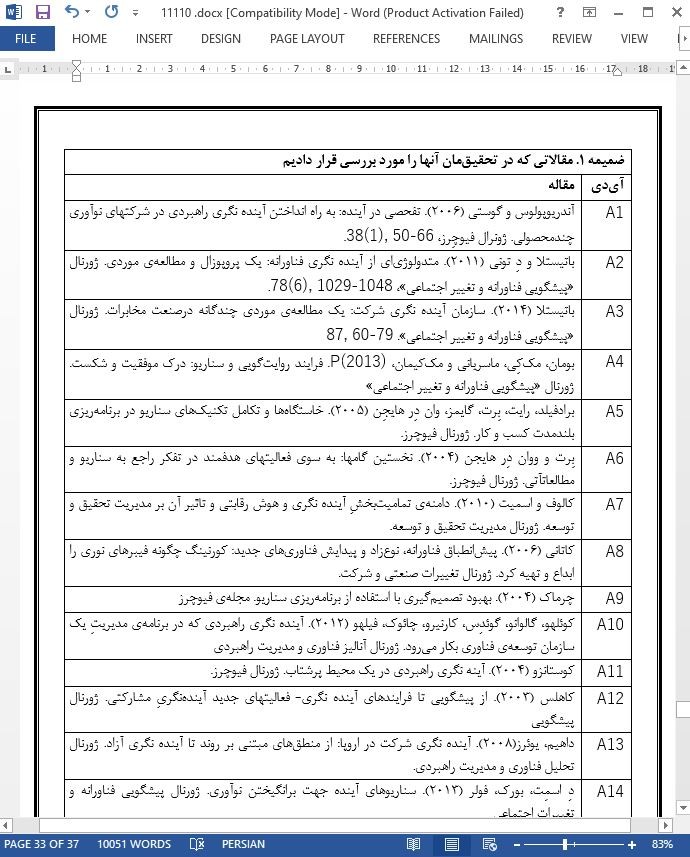
In this literature review, we systematically reviewed research articles on strategic foresight in an organizational context. We analyzed the contributions with respect to specific research questions. This review contributes to research in several ways. First, it provides a systematic overview of existing research in this area. We identified 59 significant contributions. The contributions were systematically categorized, which provides the current status of this emergent research field and will ease researchers' search for relevant studies. Second, through a thorough analysis, we proposed potential areas and approaches for future studies. The review concludes that method, organizing, and experiences are the most dominant topics in current research. The review showed that there is only limited research on motivation and use, value contribution, and innovation. We encourage researchers to join this current research area.