Abstract
In this paper, load frequency control (LFC) of a realistic power system with multi-source power generation is presented. The single area power system includes dynamics of thermal with reheat turbine, hydro and gas power plants. Appropriate generation rate constraints (GRCs) are considered for the thermal and hydro plants. In practice, access to all the state variables of a system is not possible and also their measurement is costly and difficult. Usually only a reduced number of state variables or linear combinations thereof, are available. To resolve this difficulty, optimal output feedback controller which uses only the output state variables is proposed. The performances of the proposed controller are compared with the full state feedback controller. The action of this proposed controller provides satisfactory balance between frequency overshoot and transient oscillations with zero steady state error in the multi-source power system environment. The effect of regulation parameter (R) on the frequency deviation response is examined. The sensitivity analysis reveals that the proposed controller is quite robust and optimum controller gains once set for nominal condition need not to be changed for ±25% variations in the system parameters and operating load condition from their nominal values. To show the effectiveness of the proposed controller on the actual power system, the LFC of hydro power plants operational in KHOZESTAN (a province in southwest of Iran) has also been presented.
1. Introduction
Automatic Generation Control (AGC) is an important function in modern Energy Management Systems (EMSs). The successful operation of interconnected power system requires the matching of total generation with total load demand and associated system losses. As the demand deviates from its nominal value with an unpredictable small amount, the operating point of power system changes, and hence, system may experience deviations in nominal system frequency and scheduled power exchanges [1–5]. The main tasks of automatic generation control are to hold system frequency at or very close to a specified nominal value and to maintain the correct value of interchange power between control areas [6].
7. Conclusion
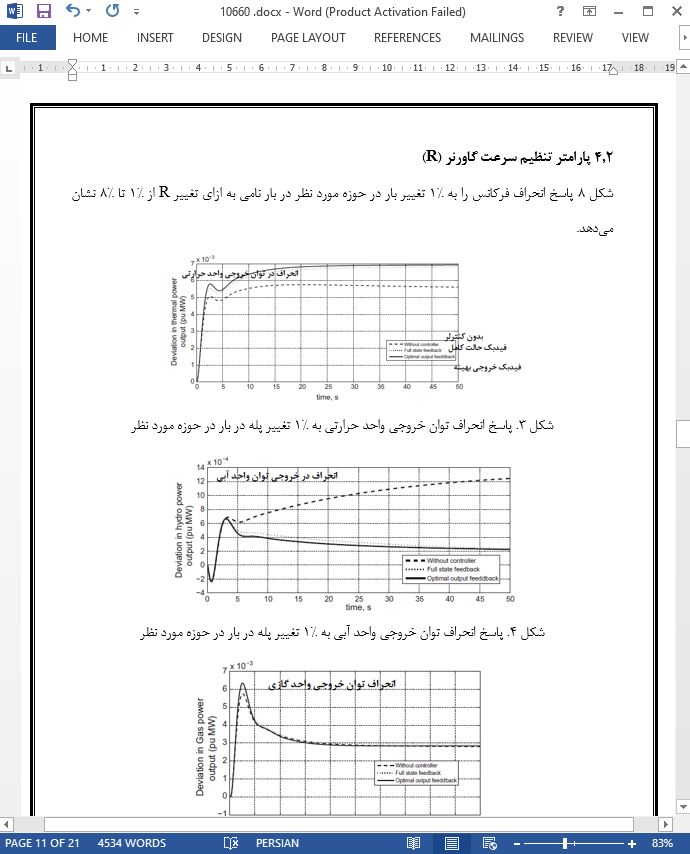
In this paper an optimal output feedback controller design method is proposed for the LFC of a realistic power system. The performance of the proposed controller is demonstrated on the multi-source power system and its dynamic responses are compared with full state feedback controller. The effect of GRC on frequency deviation response is discussed. The dynamic performance of the system deteriorates if GRC is not incorporated for realistic study of the system. Frequency deviation response of the area and generator output power deviation response to 1% step load perturbations have been obtained. The output feedback controller gives better frequency deviation response having relatively smaller peak overshoot and lesser settling time with zero steady state error as compared to full state feedback controller response. The effect of varying the regulation parameter has been examined. It is better to prefer the value of R between 3% and 4% with corresponding optimum controller gains to provide better dynamic response of AGC for the proposed system. The sensitivity analysis reveals that ±25% change in system parameters and operating load condition from their nominal values considering their optimum controller gains do not affect the system responses appreciably. Thus the optimum values of controller gains obtained for nominal system parameters and load condition are quite insensitive to wide parameter variation ±25%. The LFC of hydro power plants operational in Iran has also been studied. The proposed controller performs well on this system and improves the frequency deviation responses remarkably. Hence for all practical purposes, the controller is quite robust. Application of optimal output feedback controller is more simple and economic as lesser no. of sensors/ information is required and satisfies the LFC problem requirements.