Abstract
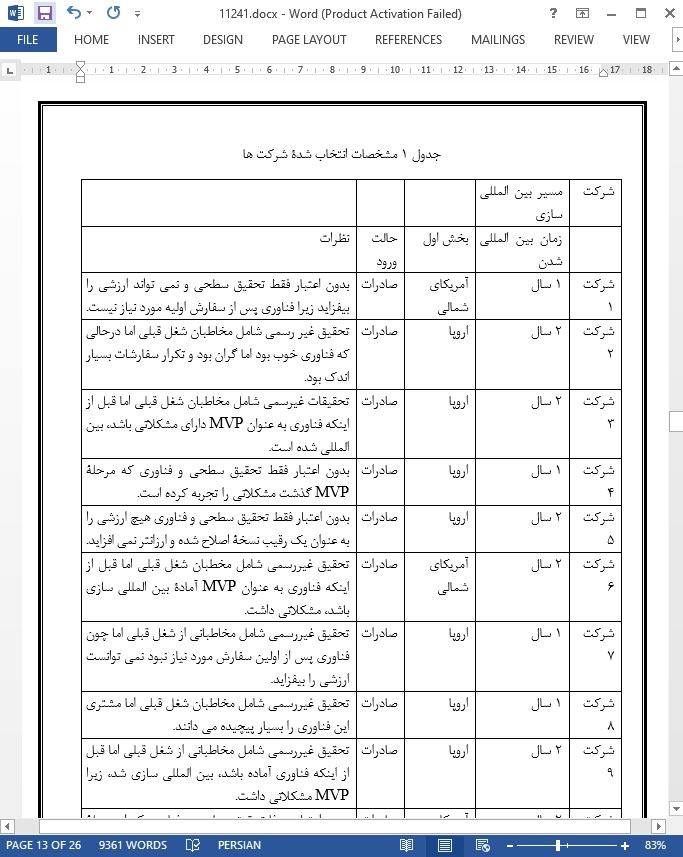
This study utilises an effectuation lens to contribute to knowledge involving the entrepreneurial marketing practices of rapidly internationalising firms, following a temporary discontinuation of overseas sales. This is important since earlier studies typically focus on continuing overseas activities, not de-internationalisation. Semi-structured interviews took place with owner-managers of sixteen small, UK based, knowledge-intensive start-ups, before planned re-internationalisation occurred. All management teams were proactive, took risks, exploited innovation and engaged in opportunity-driven plus resource leveraging behaviour. Conversely, creating adequate ‘customer value’ did not occur. The investigation highlights that in particular contexts, certain facets of an effectuation approach outweigh others and the notion of ‘affordable losses’ is viewed in both financial and non-financial terms. The study offers unique insights into the need for decision-makers in rapidly internationalising firms to undertake validation of strategies to discover new customers; also, the potential usefulness to lose particular customers, even temporarily, to facilitate enduring entrepreneurial marketing activities.
1. Introduction
1.1. Research objective
Hills & Hultman (2011, p. 3) view entrepreneurial marketing (EM) “as a spirit, an orientation as well as a process of passionately pursuing opportunities and launching and growing ventures that create perceived customer value through relationships by employing innovativeness, creativity, selling, market immersion, networking, and flexibility”. Whalen et al. (2016) suggest that EM arises from the practices of firms operating under conditions of uncertainty, providing an alternative to the traditional marketing perspective. Nevertheless, many start-up firms fail given the relative conditions of uncertainty in which they operate (Blank, 2013); hence, the issue of ‘context’ is important in considering firms' behaviour, since unique insights from particular contexts can contribute to knowledge (Jones & Rowley, 2011; Reuber, Dimitratos, & Kuivalainen, 2017). In fact, Morris, Schindehutte, and Laforge (2002, p.1) note: “marketing is context dependent, but the context is continually changing”. In this current study, ‘de-internationalisation’ provides an interesting context in which to study EM behaviour, given the potential risk or even uncertainty surrounding new ways of operating in overseas markets (Crick & Crick, 2018a; Liesch, Welch, & Buckley, 2011; Vahlne, Hamberg, & Schweizer, 2017).
5.2. Conclusions
This current study contributes to our understanding of risks/rewards in light of affordable losses associated with an effectuation-based approach (Sarasvathy, 2001); specifically, it offers insights into decision-making to facilitate enduring EM behaviour. The first conclusion arising from this investigation is that elements of effectuation-oriented decision-making are more important in certain contexts. The notion of perceived ‘affordable losses’ was prevalent following de-internationalisation. The second related conclusion is that there are different facets of ‘affordable losses’ related to financial (like profits) and nonfinancial (such as credibility) issues. The third conclusion is that adequate validation is important to avoid decision-makers acting on perceived rewards, like accepting serendipitous orders that can outweigh consideration of potential risks. It is important for owner-managers to undertake appropriate validation procedures associated with a customer discovery process (Blank, 2013; Gassmann et al., 2014; Osterwalder & Pigneur, 2010; Ries, 2011) as a quick and low-cost risk minimisation strategy before limited resources are utilised.