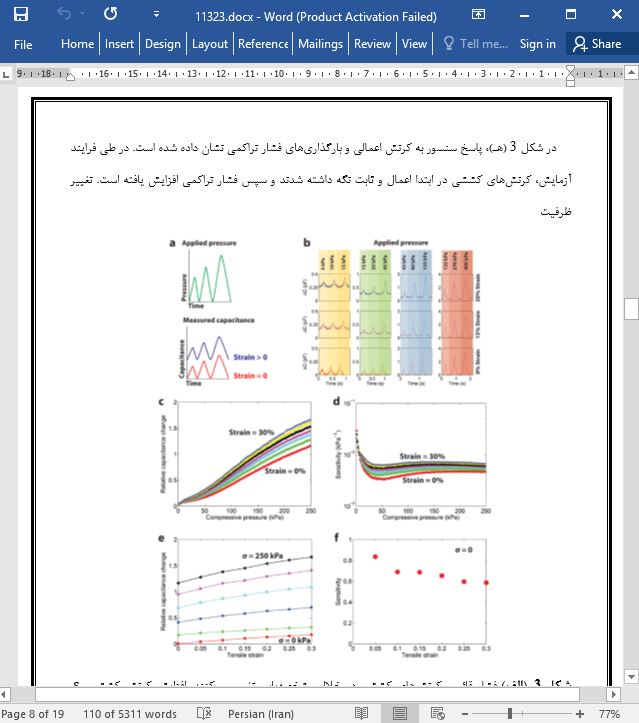
This report demonstrates a wearable elastomer-based electronic skin including resistive sensors for monitoring fi nger articulation and capacitive tactile pressure sensors that register distributed pressure along the entire length of the fi nger. Pressure sensitivity in the order of 0.001 to 0.01 kPa −1 for pressures from 5 to 405 kPa, which includes much of the range of human physiological sensing, is achieved by implementing soft, compressible silicone foam as the dielectric and stretchable thin-metal fi lms. Integrating these sensors in a textile glove allows the decoupling of the strain and pressure cross-sensitivity of the tactile sensors, enabling precise grasp analysis. The sensorized glove is implemented in a human-in-the-loop system for controlling the grasp of objects, a critical step toward hand prosthesis with integrated sensing capabilities.
1. Introduction
Individuals rely on proprioceptive and cutaneous inputs to maintain normal stance and accomplish fundamental activities of daily life. [ 1 ] Strategies to help understand and then reconstruct and restore the sense of touch are needed for areas as diverse as human haptic perception, [ 2 ] robotic manipulation, [ 3 ] control of a prosthetic limb, [ 4 ] aging, [ 5 ] clinical rehabilitation therapies following traumatic injuries, [ 6 ] and neurodegenerative diseases. [ 7 ] Touch differs from the other senses in that it spreads over the entire body. Tactile perception integrates sensory information from the skin, joints, tendons, and muscles. When grasping objects, proprioceptors report on the orientation of the hand and fi ngers while skin mechanoreceptors sense hardness and texture of the objects. In addition, skin thermoreceptors encode absolute and relative change in temperature of handled objects, and nociceptors provide alerts on harmful stimuli and interactions.
4. Experimental Section
Elastomer Preparation and Characterization : PDMS (Sylgard 184, Dow Corning) was prepared according to manufacturer suggested process by mixing the base and curing agent at a 10:1 weight ratio. Two-part Ecofl ex 00-10 (Smooth-On) was mixed at a 1:1 A:B weight ratio. Sub-millimeter thick silicone membranes were prepared by spin-coating on silicon wafers treated with a silane anti-adhesion layer (trichloro(1 H ,1 H ,2 H ,2 H - perfl uorooctyl)silane, Sigma–Aldrich). After 2 h curing at 80 °C, the membranes were then peeled from the wafers and cut to size for testing. The polyurethane (Poron 4701-30-25031-04, Rogers Corporation) and the silicone (Bisco HT800, Rogers Corporation) foam membranes were used as provided. Compression tests were performed with an Electromechanical Universal Test System (UTS) (C42.503, MTS Systems).