Abstract
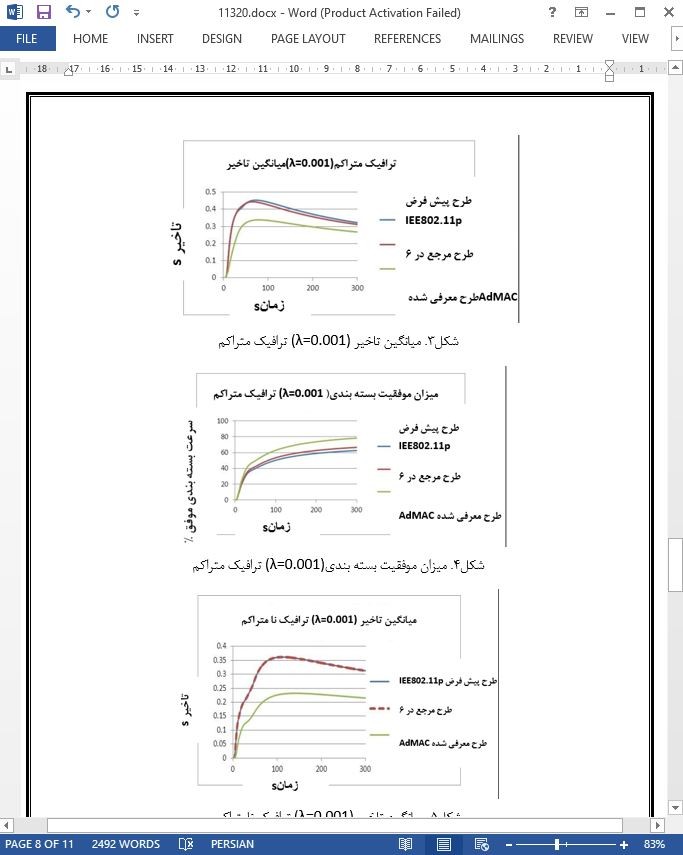
Successful and timely data delivery in evolutionary Vehicular Ad-Hoc Network (VANET) for Intelligent Transportation System (ITS) are particularly challenging due to the unique characteristics of VANET, such as fast topology change and frequent disruptions. The current VANET schemes use static parameters in an ever changing VANET topology, which results in lack of adaptability. Due to the fast topology change and frequent disruptions in VANET, a cognitive and adaptive VANET Medium Access Control (MAC) scheduling optimization protocol scheme, which is able to change its transmission parameters, to suit different topology change in VANET is preferable. In the proposed Adaptive V ANET MAC, namely AdMAC, change of signal to noise and interference ratio (SINR) is proposed as an indicator to represent VANET transmission environment and traffic density. The change of SINR is then used to determine the V ANET MAC contention window size. Simulation is conducted under congested and non-congested traffics, in the urban map of Kuala Lumpur, Malaysia. Results show that the proposed AdMAC has better adaptability, in terms of packet success rate and average delay.
I. INTRODUCTION
In VANET, vehicles drive randomly with high mobility under fast topology change and frequent disruptions [1]. The current existing schemes in VANET use parameters that do not consider transmission reliability, transmission stability, interference and traffic conditions, to optimize contention window size [2]. In order to ensure VANET suffers less packet collisions and achieve minimum delay, VANET MAC parameters have to be adaptive and optimized, to ensure VANET MAC transmission performance is maintained, under ever changing topology and frequent disruptions [3]. Currently, VANET is governed by IEEE802.11p with Enhanced Distributed Channel Access (EDCA) priority scheme [4]. The default IEEE802.11p scheme is still very much static, which makes it less feasible, under varying VANET transmission environments.
VI. CONCLUSION
VANET is an emerging technology to ensure safety through communication between vehicles. The current VANET scheme shows lack of adaptability in an ever changing transmission environment due to its static parameters. Therefore, in this paper, a novel adaptive optimized scheduling protocol for MAC layer dynamic evolutionary VANET in intelligent transportation system (ITS), namely AdMAC is proposed. In AdMAC, change of SINR is used to determine traffic density and transmission environment. The change of SINR is then used to set the contention window size for packet scheduling. High contention window size is given to unviable transmission conditions to allow packets to clear before next transmission takes place, whereas low contention window size is given to good transmission conditions to allow more packet transmissions to take place. Simulation is conducted under congested and non-congested traffic in an urban Kuala Lumpur, Malaysia map, with the use of Omnet++, SUMO, Veins and open google map applications. Results show that the proposed AdMAC shows better adaptability and optimization, under varying transmission environment, with improved packet success rate and lower average delay.