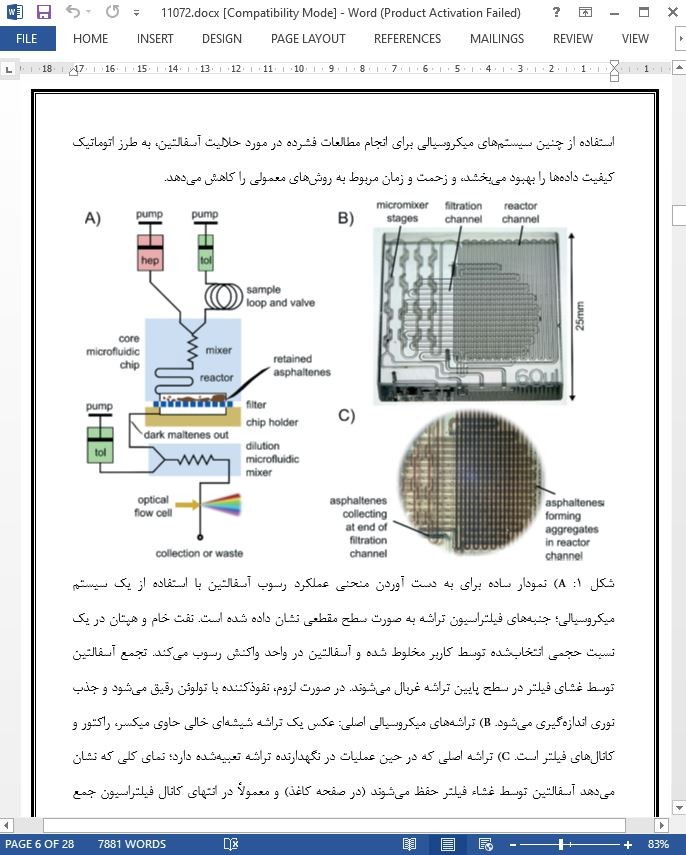
We describe a microfluidic apparatus and method for performing asphaltene yield measurements on crude oil samples. Optical spectroscopy measurements are combined with a microfluidic fluid handling platform to create an automated microfluidic apparatus to measure the asphaltene yield. The microfluidic measurements show good agreement with conventional wet chemistry measurements as well as available models. The initial absorbance of the oil is measured, and asphaltenes are removed from the oil by the gradual addition of n-alkane, which leads to flocculation and subsequent filtration. The absorbance of the de-asphalted oil (maltenes) is then measured and the initial asphaltene content is determined by the change in absorbance. The solubility of asphaltene is evaluated by varying the titrant-to-oil ratio (e.g., n-heptane– oil), which induces no, partial, or full precipitation of asphaltenes depending on the chosen ratio. The absorbance of the filtrate is measured and normalized to the maximum content to determine the fractional precipitation at each ratio. Traditionally, a yield curve comprised of 20 such ratios would require weeks to months to generate, while consuming over 6 L of solvent and more than 100 g of crude oil sample. Using the microfluidic approach described here, the same measurement can be performed in 1 day, with 0.5 L of solvent and 10 g of crude oil sample. The substantial reduction in time and consumables will enable more frequent asphaltene yield measurements and reduce its environmental impact significantly.
Introduction
Asphaltene precipitation and deposition is a major impediment in production, transportation and processing of reservoir fluids. Unexpected precipitation and the subsequent potential for deposition of asphaltenes can cause reservoir impairment, plugging of wells and flowlines, as well as fouling issues and processing challenges for surface facilities.1 However, the mechanisms of agglomeration and deposition are not fully proven,1,2 with only a few available predictive models.3 Asphaltenes are a sub-component of crude oil that are conventionally defined as being poorly soluble in n-alkanes (e.g. n-heptane), and highly soluble in aromatic solvents (e.g. toluene).4 Asphaltenes precipitate due to a shift in solubility matrix caused by a change in pressure, temperature, or composition of the oil.5–8 For example, simply combining two incompatible oils may initiate precipitation through a change in composition; even though, both stand-alone samples have asphaltene fractions that otherwise remain stable in solution.9,10 Optimal flow assurance requires frequent and accurate fluid characterization and asphaltene phase behavior studies for each crude sample. Quantitative measurements that describe the degree of asphaltene precipitation in response to varying perturbations aid in understanding the general behavior of these diverse aggregates and help mitigate or prevent costly remedial techniques to remove the problematic material.
Conclusions
In this study, we have introduced a microfluidic apparatus for rapidly obtaining the yield curve for a sample of crude oil. The system is built upon a technique for measuring asphaltenes using optical spectroscopy combined with a microfluidic fluid handling platform. To build each yield curve, tens of asphaltene solubility measurements in heptane are completed in one day instead of the several weeks to months required by conventional approaches. The microfluidic system also produced 10-fold less waste, oil and solvent, making the system portable and more cost-effective for such resource intensive studies. We have shown that the precipitation onset and maximum precipitation can be determined from the data and that regular solution models can be tuned to model the data reasonably well. Generally, such microfluidic systems will enable fast, accurate, repeatable and cost-effective solubility measurements for tuning petroleum processes and models.