Abstract
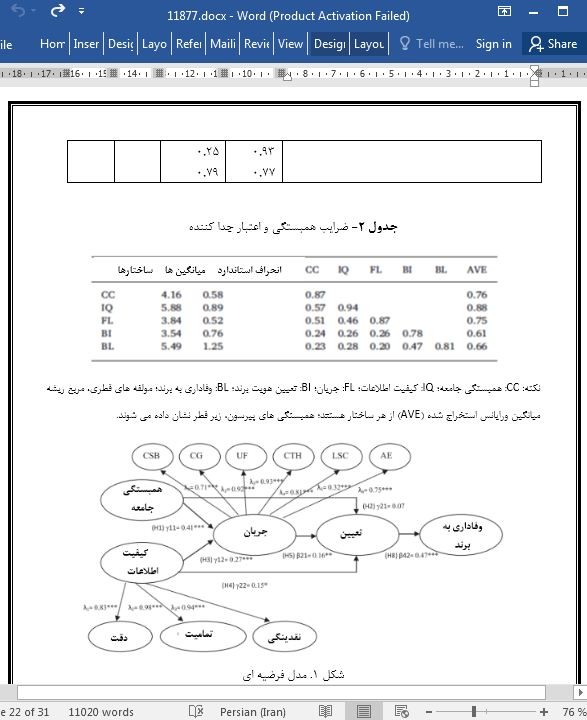
Based on the flow theory from positive psychology, we propose that flow could be generated by brand community characteristics and plays an important role in influencing brand community members' attitudes toward a brand. Specifically, we propose a model that identifies brand community characteristics (i.e., community cohesiveness and information quality) that produce flow and explore how flow impacts brand identification and brand loyalty. Members from 31 automobile brand communities participated in this survey study, and 580 validated questionnaires were returned. Structural Equation Model was used to test the research hypotheses. The results show that community cohesiveness and information quality positively influence flow. Flow positively influences members' brand identification and, subsequently, impacts brand loyalty. The mediating role of flow in building brand identification is also demonstrated.
1. Introduction
In recent years, marketers have been using brand communities (e.g., Jeep, Apple, HTC smartphones) to build brands (McWilliam, 2000). A brand community can be defined as a “…group of consumers with a shared enthusiasm for the brand and a well-developed social identity, whose members engage jointly in group actions to accomplish collective goals and/or express mutual sentiments and commitments” (Bagozzi and Dholakia, 2006, p. 45). It provides consumers with a variety of information pieces, such as products, user experience and competition between companies. It can also be used to enhance brand loyalty and commitment (Muniz & O'Guinn, 2001). While prior research identified the important impact brand communities have on product marketing and brand equity (Laroche, Habibi, Richard, & Sankaranarayanan, 2012; Zaglia, 2013), few managers understand how to achieve these benefits (Fournier & Lee, 2009). There is much left to explore about the mechanism underlying the influence of brand communities on consumer behavior and branding. Therefore, our research attempts to achieve this end.
6. Limitations and future research
Our research has some limitations. First, we only considered a select number of brand community characteristics. In future studies, researchers may want to identify other possible brand community characteristics that might also produce flow. For example, the SAP Community Network, which has over 2.5 million members, provides incentives to community contributions. It would be interesting to examine whether and how a reward system in the brand community influences flow and brand loyalty. Second, we did not control for members' involvement and expertise. Moreover, because we adopted snowball sampling, the samples would not be representative of each brand community in order to perform any comparisons between the communities. Future research may want to control for or manipulate some of these variables in order to see how they influence the observed effects in our study. Third, this research investigated automobile brand communities in Taiwan. Thus, the samples from this specific brand community in Taiwan may limit the generalizability of the findings. Companies in various industries from consumer products (e.g., Being Girl operated by Procter & Gamble) to beverages (e.g., My Starbucks Idea run by Starbucks) attempt to leverage of power of brand communities. Future research should examine the robustness of the proposed model across brand communities in different industries.