Abstract
Despite calls for political consensus, there is growing evidence that the public response to the COVID-19 pandemic has been politicized in the US. We examined the extent to which this polarization exists among the US public across two national studies. In a representative US sample (N = 699, March 2020) we find that liberals (compared to conservatives) perceive higher risk, place less trust in politicians to handle the pandemic, are more trusting of medical experts such as the WHO, and are more critical of the government response. We replicate these results in a second, pre-registered study (N = 1000; April 2020), and find that results are similar when considering partisanship, rather than political ideology. In both studies we also find evidence that political polarization extends beyond attitudes, with liberals consistently reporting engaging in a significantly greater number of health protective behaviors (e.g., wearing face masks) than conservatives. We discuss the possible drivers of polarization on COVID-19 attitudes and behaviors, and reiterate the need for fostering bipartisan consensus to effectively address and manage the COVID-19 pandemic.
1. Introduction
“This is not the one to use for politics. It’s like playing with fire… Please work across party lines, across ideology, across beliefs, across any differences for that matter. We need to behave. That’s how we can defeat this virus.
” (Tedros Ghebreyesus, Director-General, World Health Organization, 2020, p. 6)
As countries around the world are designing policies and legislation to fight and contain a global pandemic, over half a million deaths have been recorded due to the novel coronavirus (SARS-CoV-2) with almost a quarter of those deaths occurring in the United States alone (CSSE, 2020). In the absence of a scalable vaccine or effective antiviral treatment, scholars have increasingly noted the important role of the social sciences in evaluating public opinion and the impact of nonpharmaceutical interventions (Van Bavel et al., 2020) such as mask wearing, social distancing, hand washing, and self-isolation. Crucially, the effectiveness of these interventions not only depends on an emerging scientific understanding of viral transmission dynamics (Zhang, Li, Zhang, Wang, & Molina, 2020) but also on the degree to which people voluntarily adopt and coordinate their behavior in the population at both local and global scales. As the Director-General of the WHO warns, increasing political polarization presents a direct threat to the effective management of the pandemic.
4. Discussion
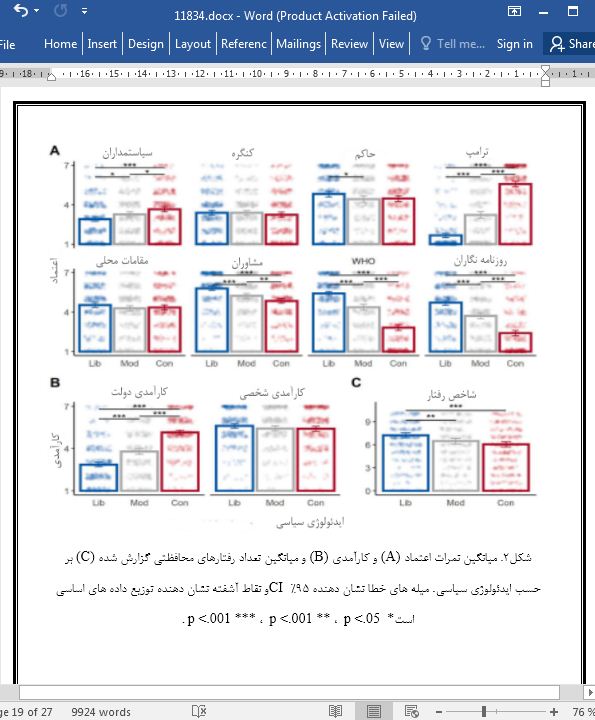
Political orientation is associated with views on a panoply of social issues (Jost et al., 2003; Sterling, Jost, & Hardin, 2019), and the results of the two studies presented here show COVID-19 is no exception. Across two national studies we report that conservative political ideology is significantly linked to greater trust in government authorities to manage COVID-19, lower trust in scientists and the WHO and lower perceived risk of the virus. We also report that these ideological differences are significantly associated with behavior: conservative participants reported fewer protective actions such wearing a mask or handwashing. In the case of Study 2, results proved robust and were further corroborated with an alternative measure of political orientation: party identification (see supplementary materials). These effects were also not trivial, nearly all significant partisan differences revealed standardized effect-sizes in the range of medium to high (Cohen, 1988; Funder & Ozer, 2019).