Abstract
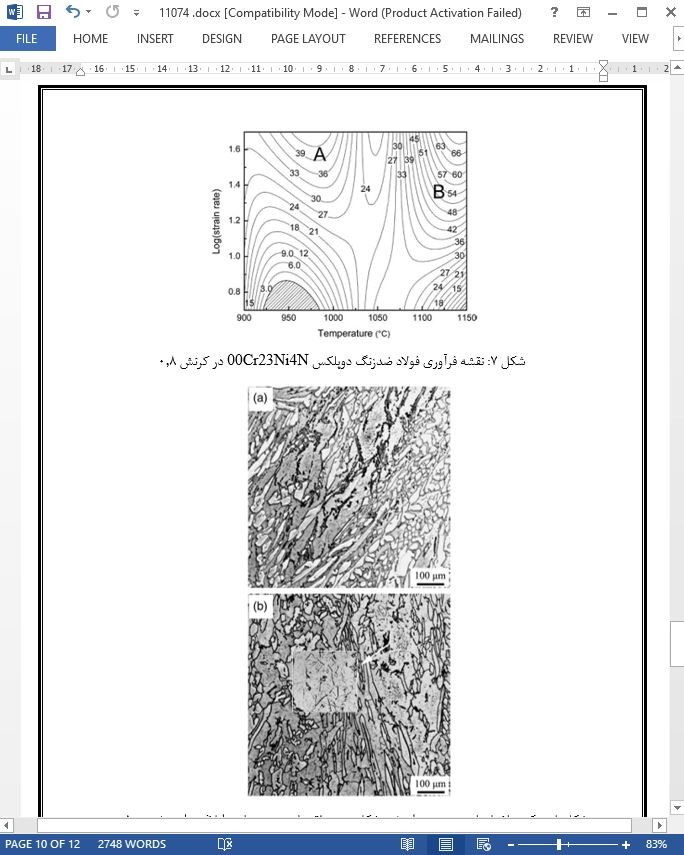
The hot deformation behavior of 00Cr23Ni4N duplex stainless steel under medium–high strain rates (5–50 s− 1) has been analyzed using the Zener–Hollomon parameter and processing maps, which is based on compression tests made at temperatures ranging from 900 to 1150 °C. The results display the significant influence of high strain rate and high temperature on hot deformation behavior of 00Cr23Ni4N duplex stainless steel. A classical hyperbolic sine equation is applied to reveal the relations between the peak stress, strain rate and deformation temperature, in which the activation energy, Q and stress exponent, n are 263.4 kJ/mol and 2.6, respectively. The Zener–Hollomon parameters at low and high temperatures are calculated respectively to reflect the microstructural evolutions. Based on the processing map obtained, an ideal hot working condition for commercial processing is in the temperature range between 1075 and 1150 °C with a strain rate of 10 to 30 s− 1. Under such condition, both ferrite and austenite dynamic re-crystallizations can be obtained and the corresponding Zener–Hollomon parameter is relatively low. Furthermore, the unstable domains are indicated by the processing map.
1. Introduction
Due to the excellent combination of high strength and toughness, good weldability with superior resistance under critical working conditions, duplex stainless steel has been widely used in diverse fields, such as petroleum refining, paper manufacturing and ocean industries etc. [1–3]. Such good properties of duplex stainless steel rely on a two-phase microstructure comprised by approximately equal amounts of austenite and ferrite [4]. Therefore, the high performance and special microstructures have made duplex stainless steel a special class in all stainless steels.
4. Conclusions
The hot deformation behavior of 00Cr23Ni4N duplex stainless steel under medium–high strain rates is studied in compression at temperatures from 900 to 1150 °C. Below is the results obtained:
(1) The classical hyperbolic sine equation can be adopted to describe the relationship among the peak stress, strain rate and deformation temperature, in which the mean activation energy, Q and n are 263.4 kJ/mol and 2.6 respectively.
(2) The lower the Z parameter, the lower the flow stress, the lower the activation energy and the more easily the dynamic re-crystallization may occur.