Abstract
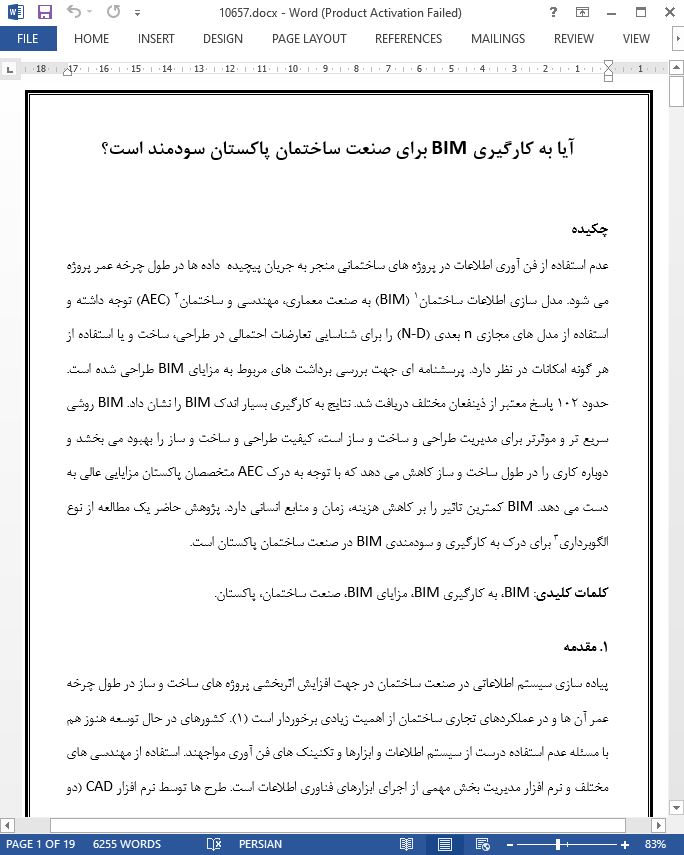
Lack of Information technology applications on construction projects lead to complex flow of data during project life cycle. Building Information Modeling (BIM) has gained attention in the Architectural, Engineering and Construction (AEC) industry, envisage the use of virtual n-dimensional (n-D) models to identify potential conflicts in design, construction or operational of any facility. A questionnaire has been designed to investigate perceptions regarding BIM advantages. Around 102 valid responses received from diversified stakeholders. Results showed very low BIM adoption with low level of ‘Buzz’. BIM is a faster and more effective method for designing and construction management, it improves quality of the design and construction and reduces rework during construction; which came out as the top thee advantages according to the perception of AEC professionals of Pakistan.BIM has least impact on reduction of cost, time and human resources. This research is a bench mark study to understand adoption and advantageous of BIM in Pakistan Construction Industry.
1. Introduction
Implementation of Information system in the construction industry has been an issue of great importance in order to enhance the effectiveness of construction projects throughout their life cycle and across different construction business functions[1]. Developing nations still lack in true utilization of information system and technology tools and techniques. Usage of different engineering and management software is a critical part of implementing IT tools. Drawings are prepared in CAD software (two dimensional approach) [2]. The traditional project delivery approach for construction projects, Design-Bid-Build, fragments the functions of stakeholders during design and construction phases. In other words, it hinders the joint involvement of the construction contractor or the project manager during the design phase of the project. The use of general and conventional two dimensional CAD drawings does not support a true collaborative approach. Architects and engineering consultants produce their own fragmented CAD design drawings / documents to relay theirs designs to owners and contractors. These drawings are not integrated and usually pose clash of information which results into inadequacy in labour productivity. The estimators need to calculate and produce their own quantity take offs based on the CAD documents produced by consultants. Moreover, the 2D CAD approach does not endorse the integration of the drawings with schedule and cost. Due to unpredictable demand and unique site requirements the construction companies are very small specialized and regional firms.
7. Conclusions and Recommendations
Current state of BIM adoption is not satisfactory in Pakistan. Only 27% of AEC organizations are using BIM or involve if BIM adoption process in any capacity. 73% organizations are neither using BIM nor involved in BIM adoption process in any capacity. There is earnest need of technology transfer (BIM) to Construction stakeholders. Conventionally, coordination among employer and employee (designer, contractor, supplier, etc.) is not effective. Specifically, both consultant and contactor have no effective channel to provide progress monitoring for evaluation of performance for project life cycle. [31, 32] According to a research study for measuring effectiveness of websites as business tool (referring projects), both consultants and contractors have poorly designed websites, without appropriate progress monitoring facility. In this stance, adoption of integrated design is highly needed to avoid coordination issues.