Abstract
Consumer psychology faces serious issues of internal and external relevance. Most of these issues originate in seven fundamental problems with the way consumer psychologists plan and conduct their research—problems that could be called “the seven sins of consumer psychology.” These seven “sins” are (1) a narrow conception of the scope of consumer behavior research; (2) adoption of a narrow set of theoretical lenses; (3) adherence to a narrow epistemology of consumer research; (4) an almost exclusive emphasis on psychological processes as opposed to psychological content; (5) a strong tendency to overgeneralize from finite empirical results, both as authors and as reviewers; (6) a predisposition to design studies based on methodological convenience rather than on substantive considerations; and (7) a pervasive confusion between “theories of studies” and studies of theories. Addressing these problems (“atoning for these sins”) would greatly enhance the relevance of the field. However, this may require a substantial rebalancing of the field's incentives to reward actual research impact rather than sheer number of publications in major journals.
Introduction
In a number of respects, the field of consumer psychology is doing very well. It is growing very rapidly, as is reflected by (a) the size of our main professional organizations, the Association for Consumer Research (ACR) and the Society for Consumer Psychology (SCP), (b) the number of manuscripts submitted to our main journals, (c) the high attendance at our major conferences, and (d) the number of conferences and outlets now open to consumer researchers. In addition, in some respects, our research has become more rigorous and sophisticated over the years, both theoretically and methodologically. Whereas single studies and simple ANOVAs used to be the norm in our top journals, nowadays typical articles contain three or more studies, painstakingly rule out most alternative explanations, and report increasingly complex analyses. Finally, the field has become more inclusive. Whereas publications in the most prestigious journals used to be confined to a fairly limited set of scholars from a limited number of academic institutions, today articles in our top journals are authored by a much larger community of researchers from a much broader range of institutions, including many outside North America.
Conclusion
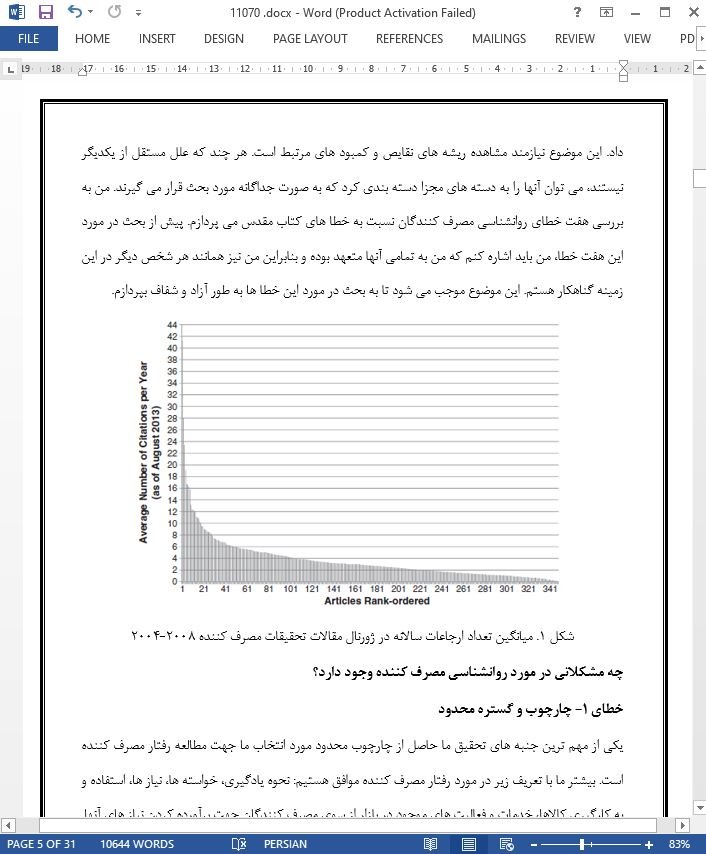
A roadmap for greater relevance In summary, consumer psychology faces serious issues of relevance. Not only is our research not as relevant as it should be with respect to our external constituents—businesses, policy makers, and consumers at large—but the bulk of it, perhaps 70%, is not particularly relevant to our internal constituents either (other consumer researchers and social scientists). To increase the relevance of our work, both internal and external, the field needs to address seven fundamental problems in the way consumer psychologists plan and conduct their research— the seven sins of consumer psychology. A concerted effort to correct these sins provides a clear roadmap for how consumer psychology needs to evolve