Abstract
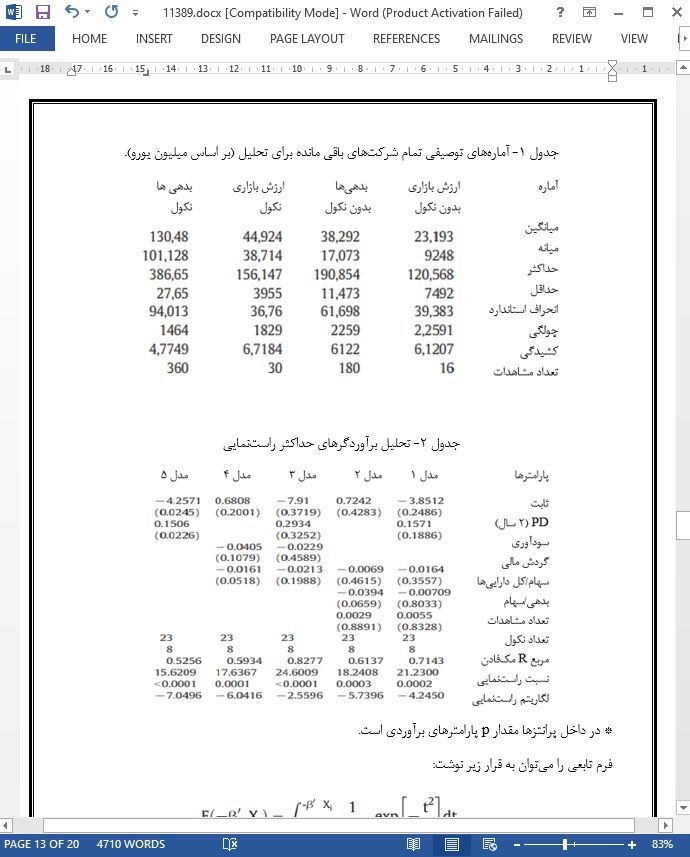
This paper combines fundamental analysis and contingent claim analysis into a hybrid model of credit risk measurement. Our database consists of French companies listed on the Paris Stock Exchange (Euronext Paris). Our objective is to assess how the combination of continuous assessments provided by the market and the values derived from financial statements improve our ability to forecast the default probability. During the first phase, the default probability is estimated using both methods separately, and subsequently, the default probability of the structural model is integrated at each point in time in the non-structural model as an additional explanatory variable. The appeal of the hybrid model allows the default probability to be continuously updated by integrating market information via the probabilities of default extracted from the structural model. Our results indicate that default probabilities extracted from the structural model contribute significantly in explaining default risk when included in a hybrid model with accounting variables.
1. Introduction
Credit risk refers to the risk due to unpredicted changes in the credit quality of a counter party or issuer and its quantification is one of the major frontiers in modern finance. The creditworthiness of a potential borrower affects the lending decision and the credit spread, since it is uncertain whether the firm will be able to perform its obligation. Credit risk measurement depends on the likelihood of default of a firm to meet its required or contractual obligation and on what will be lost if default occurs. When we consider the large number of corporations issuing fixed income securities and the relatively small number of actual defaults might regard default as rare event. However, all corporate issuers have some positive probability of default. Models of credit risk measurement have focused on the estimation of the default probability of firms, since it is the main source of uncertainty in the lending decision. We may distinguish two large classes of credit risk models. The first class of traditional models assumes the fundamental analysis, called the non-structural models. The goal of these models that goes back to Beaver (1966) and Altman (1968) is to find significant factors in assessing the credit risk. The second class, called structural models assumes the contingency claim analysis. The models refer to Black and Scholes (1973) and Merton (1974) and assume corporate liabilities as contingent claims on the assets of the firm.4
5. Conclusion
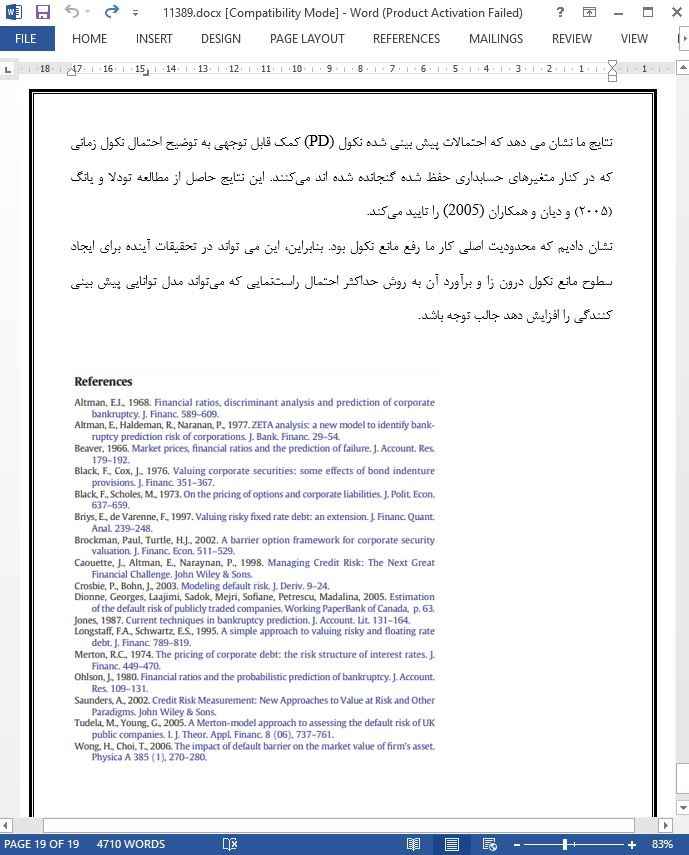
Default led to the international global financial crisis in 2007–2008. Credit risk measurement is an area of great and renewed interest for both academicians and practitioners. Banks have to estimate defaults of their clients. In this paper, we investigate a major component of credit risk, the probability of default using a methodology in the spirit of Tudela and Young (2005). The methodology is applied to a sample of French companies whose shares are traded on the Stock Exchange Paris. This model has investigated the ability of hybrid models to calculate the default risk of UK companies by verifying whether combining the structural and the non-structural models into a hybrid model yields a better measure of the default risk than those obtained from structural and traditional non-structural models estimated separately.