Abstract
Self-absorption describes a pathological tendency towards the internal mental world (internalization) that often conflicts with the accurate monitoring of the external world. In performance monitoring, an augmented electrophysiological response evoked by internal signals in patients with anxiety or depressive disorder seems to reflect this tendency. Specifically, the error-related negativity (Ne/ERN), an index of error processing based on internal signals, is larger in patients compared to controls. In the present experiment, we investigated whether the preferential processing of internal signals in patients is linked to diminished and inflexible external signal processing. To this end, the electrophysiological response evoked by external signals was analysed in patients with panic disorder and healthy controls. Participants performed a choice-response task, where informative or uninformative feedback followed each response, and a passive viewing task. As a replication of previous studies, patients presented an augmented Ne/ERN, indexing enhanced processing of internal signals related to errors. Furthermore, the vertex positive potential (VPP) evoked by visual stimuli was larger in patients than in controls, suggesting enhanced attention to external signals. Moreover, patients and controls showed similar sensitivity to the feedback information content, indicating a normal flexibility in the allocation of monitoring resources to external signals depending on how informative these signals are for performance monitoring. These results suggest that the tendency towards internal signals in patients with panic disorder does not hinder the flexible processing of external signals. On the contrary, external signals seem to attract enhanced processing in patients compared to controls.
Introduction
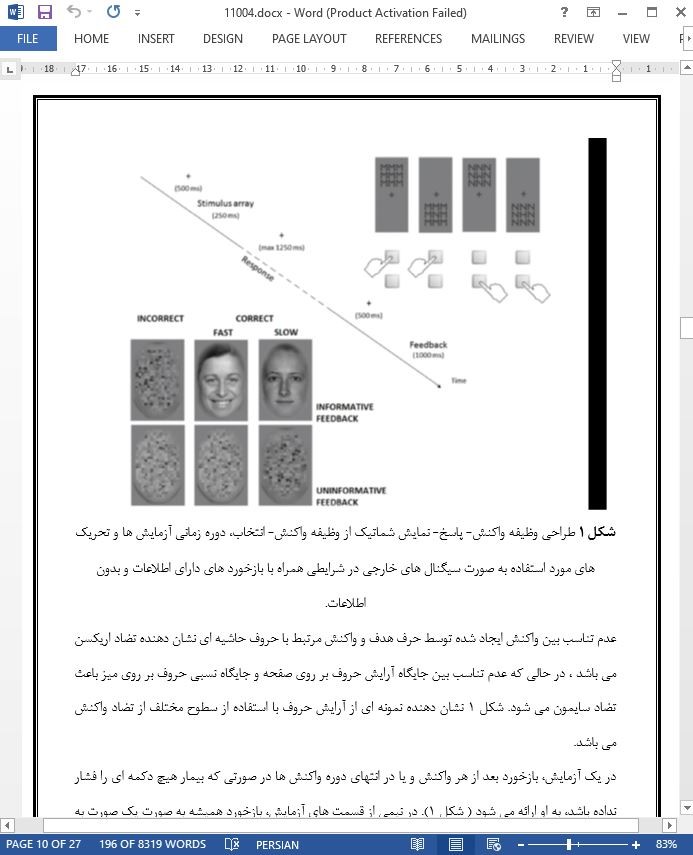
A balanced processing of the internal mental world and the external world is a key aspect for everyday well-being. In fact, a pathological tendency towards the internal world (internalization) is a common factor in psychological disorders characterised by anxiety, depression, and obsessive-compulsive symptoms [1, 2]. Although internal attention is often appropriate, many situations require stronger attention to information from external sources; consequently, a rigid, excessive and sustained self-focused attention could hamper a realistic evaluation of oneself based on relevant environmental signals. Ingram [3] described the inflexible focus towards internal signals with the concept of self-absorption. With the present study, we employed electrophysiological recordings in an experimental context of performance monitoring to test whether patients with a psychological disorder characterised by internalization (i.e. panic disorder) present a deficit in the flexible processing of internal and external signals and whether the tendency towards internal signals hinders the accurate processing of external signals. To this end, we employed an experimental design where participants could evaluate their performance in a response-choice task based on self-generated signals or feedback. This experiment enabled the analysis of potential differences in the flexible and accurate processing of internal and external signals between patients and controls as modulations of the error-related negativity (Ne/ERN; [4, 5]), an index of internal monitoring, and the N170/VPP complex [6], an index of attention on external visual stimuli [7].
Discussion
Panic disorder, like other psychological disorders associated with anxiety, depression, or obsessive-compulsive symptoms, is considered a mental illness characterised by a pathological tendency towards the internal world that often leads to withdrawal from the external world. The present experiment investigated whether patients with panic disorder present a deficit in the flexible processing of external signals for performance monitoring. We expected that the enlarged processing of internal signals in panic disorder occurred with a reduced and inflexible processing of external signals. Contrary to the prediction of withdrawal from the external world, ERPs evoked by feedback signals were larger in patients than in controls. Interestingly, augmented processing of external signals in patients was not restricted to feedback in the context of performance monitoring but generalised to pictures of faces and houses in a passive viewing task. Moreover, despite the abnormal processing of external signals in panic disorder, patients and controls showed a similar sensitivity to the feedback information content suggesting a normal attitude to process an external information according to contextual factors.