Abstract
Modern structural design requires consideration of sustainability parts from a life cycle perception, but also the initial design phase in which seismic actions have a substantial influence on the design of the structure. In recent times, the seismic assessment of masonry buildings by means of macro-element modeling methodologies has become popular, by application of performance-based evaluation techniques using nonlinear lateral load procedures (Pushover). This study addresses the endorsement of these methodologies by referring to two full-scale brick masonry structures subjected to a lateral loading conditions. The lateral load response of tested unreinforced masonry (URM) and confined masonry (CM) structures is compared with the response of the numerical models. The considered numerical models have good agreement for satisfactorily predicting the response of the experimental test and hence are capable of being used in a performance-based evaluation. Then, pointing to the characteristic housing of northern Pakistan and its typical design with a reinforced concrete (RC) building, the validated numerical models are used to estimate the hazard-resistant potentials of the URM and CM options for one, two and three story options, particularly in relation with maximum lateral load capacity. The load deformation response of both the typologies was also compared for the mentioned three story levels. It was observed that by confining the masonry its ductility capacity increases considerably, hence making it more suitable to be used in earthquake prone regions. Masonry structures are also compared regarding the construction costs compared to the RC typology. With regard to the dwellings studied, the projected lateral load behavior for masonry structures indicate the ability to withstand lateral loads adequately. These structures also allow a significant reduction in costs (up to 28%) compared to RC, hence appearing as challenging alternatives.
1. Introduction
The building construction has a great effect on the total budget of a family. Furthermore, people live the maximum part of their lives in the buildings. Low rise structures (three story or less) are the common type for houses, demanding thus specific consideration in the development of workable solutions for their construction. The accepted construction solution indicates itself as an essential primary investment for house construction and is taken as the emphasis of this study.
5. Conclusions
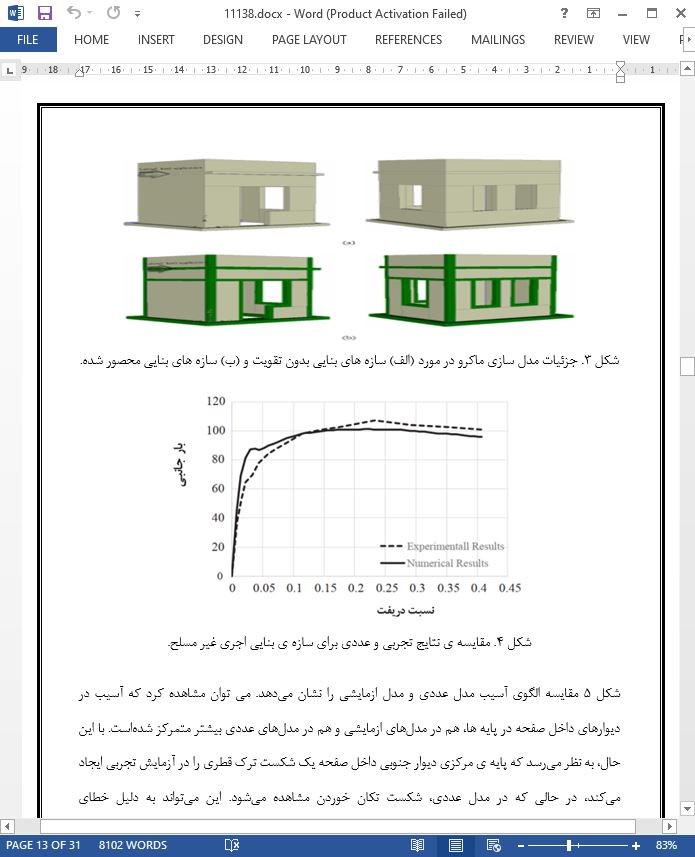
This study proposes a contribution about the design and development of cost-effective structures in seismic areas. For this reason, the tools offered for the seismic assessment of unreinforced masonry (URM) and confined masonry (CM) structures are presented and corroborated against experimental indication. In general, the assessment tool presented, provided a reasonable estimate of the capacity curve from the lateral load analysis, specifically initial stiffness, ultimate strength and ductility, hence being precise enough to be adopted in performancebased assessment. Additionally, the software permit simulating the configurations of actual masonry buildings. Regarding a genuine case of a single-story, double-story and triple-story dwellings, simulations are performed to evaluate its earthquake-resistant performance and an assessment of the cost of construction is made for masonry solutions in comparison with the typical RC frame.