ABSTRACT
Although Business Intelligence is seen as priority by many companies, the level of benefits achieved varies significantly between firms. Researchers have indicated that not having an effective Business Intelligence strategy is a significant issue in regards to trying to realize organizational benefits. This paper adopting a case study method investigates a retail company’s Business Intelligence adoption and the development of a Business Intelligence strategy that directly informed the firm’s information needs. The important elements of this strategy included using a set of guiding principles to ensure that there was a close alignment of Business Intelligence outcomes with the company’s needs. The paper provides insights for researchers and practitioners on the important factors need to be considered to achieve effective Business Intelligence.
INTRODUCTION
Companies today have come to realize the importance of providing accurate, relevant and timely information— information that allows their organisational personnel to engage in effective decision-making practices (Isik et al, 2013). Indeed, early work by Evans and Wurster (1997, pp.72) in their paper on Information Economics stated that “… information is the glue that holds business together”. Companies have developed and implemented information systems to facilitate the collection, processing and dissemination of information. One such system, Enterprise Resource Planning (ERP) system, has enabled companies to gain efficiencies in their business processes and associated transactions through the high degree of integration of their company-wide business processes, and the standardisation of the associated data (Davenport et al, 2003). ERP systems are an essential element of the corporate information systems infrastructure allowing businesses to be competitive in today’s world, as well as providing foundation for future growth (Chou et al, 2005).
CONCLUSION
The case study documented in this paper provides an example of a Business Intelligence strategy developed for a utilities company. This strategic approach could be equally applied to companies in other industry sectors. The Business Intelligence history of the company demonstrates the iterative approach companies experience as they mature and identify the short comings of their existing Business Intelligence approaches.
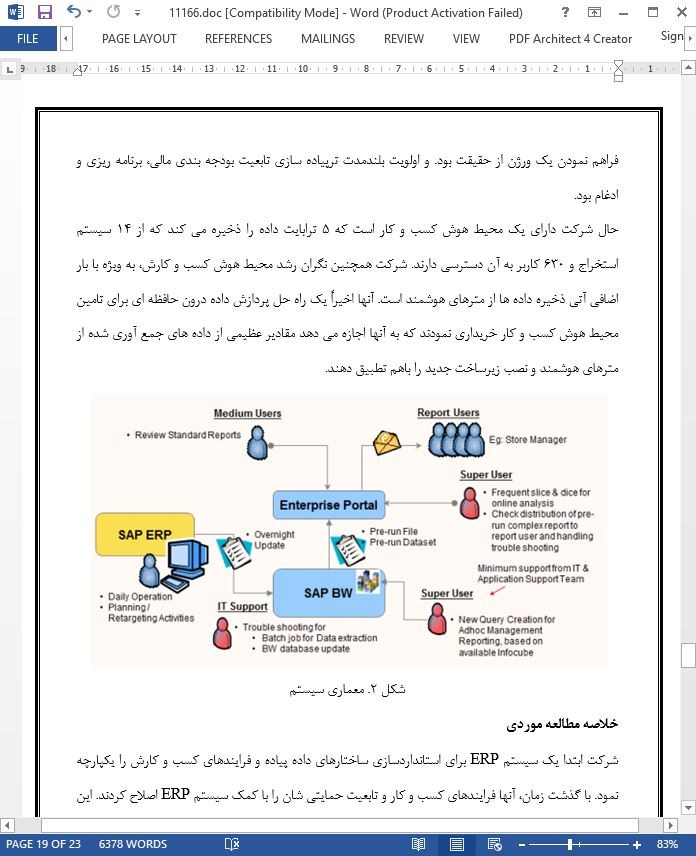
Since conducting the initial interviews there have been further developments on the requirements of the company’s Business Intelligence needs to support. These requirements are associated with the storage and analysis of large disparate data sets (Big Data). Victoria in 2011 introduced smart metering to households throughout the state. The implication of this is that the case study company collects readings for approximately 800,000 metres every half hour. This data needs to be stored, analysed and made available to consumers. The company is implementing SAP’s inmemory database (HANA) to assist with this analysis.