Abstract
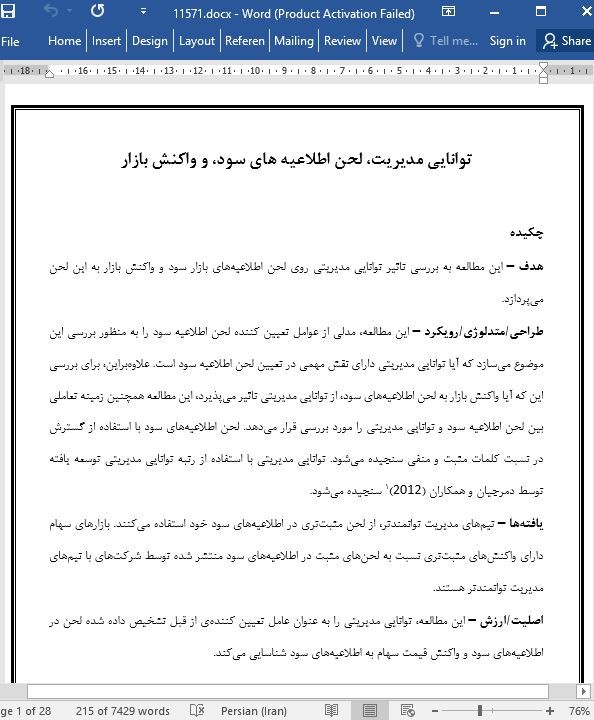
Purpose − This study examines the effect of managerial ability on the tone of earnings announcements and on the market response to the tone.
Design/methodology/approach − This study constructs a model of the determinants of earnings announcement tone in order to examine whether managerial ability plays a significant role in determining earnings announcement tone. Further, to test whether the market response to the tone of earnings announcements is affected by managerial ability, this study also examines the interactive term between earnings announcement tone and managerial ability. The tone of earnings announcements is measured using the spread in the proportion of positive and negative words. Managerial ability is measured using the managerial ability rank developed by Demerjian et al. (2012).
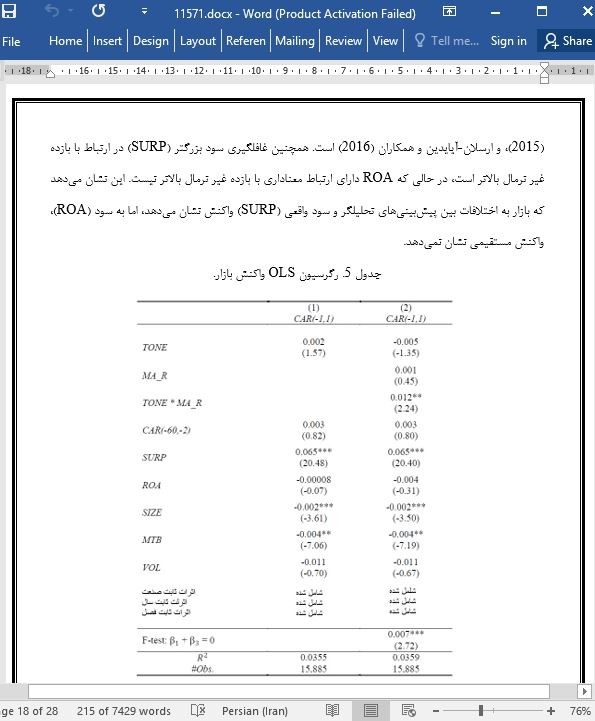
Findings − More able management teams use a more positive tone in their earnings announcements. Stock markets have more pronounced positive reactions to positive tones in the earnings announcements issued by companies with more able management teams.
Originality/value – This study identifies managerial ability as a previously unrecognized determinant of tone in earnings announcements and of the stock price reaction to earnings announcements.
1. Introduction
To what extent does management team ability affect the language used in a firm’s earnings announcement? Perhaps the most commonly studied feature of corporate communication is the spread in the proportion of positive and negative words—often referred to as “tone” (e.g., Frankel et al., 2010; Price et al., 2012; Davis and Tama-Sweet, 2012; Davis et al., 2012; Demers and Vega, 2014; Huang et al., 2014; Arslan-Ayaydin et al., 2016). Prior studies have found that the tone of corporate disclosure is related to both current firm profitability and to management incentives. This study explores an alternative determinant of tone, i.e., managerial ability, which is defined as a management team’s efficiency, relative to its industry peers, in transforming corporate resources into revenues (Demerjian et al., 2012).
7. Conclusions
Using the ranked managerial ability measure developed by Demerjian et al. (2012), this study examines the effect of managerial ability on the tone of earnings announcements and on the market response to the tone. The study finds that more able management teams use a more positive tone in their earnings announcements; this extends the list of known tone determinants documented in the literature, such as operational performance, managerial incentives, growth opportunities, and firm size. These results add to the understanding of the determinants of tone in earnings announcements and suggest that tone does not simply reflect a manager’s private information about operational performance. Rather, the tone in earnings announcements is related to the management team’s efficiency in converting corporate resources into revenue. Moreover, the results of this study suggest that stock markets have more pronounced positive reactions to positive tones in the earnings announcements issued by companies with more able management teams. In other words, investors put more weight on positive tones expressed by more able management teams. Thus, this study adds to the understanding of the market’s reaction to earnings announcements. Overall, the study contributes to the understanding of both the determinants of and market reaction to the tone of earnings announcements and to the understanding of the effect of managerial ability on firms’ financial reporting behavior.