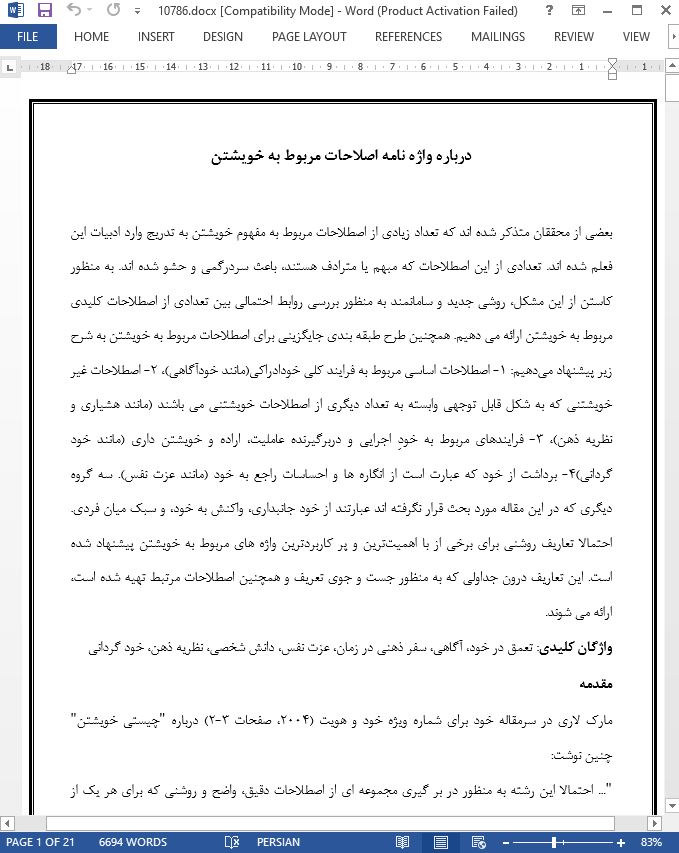
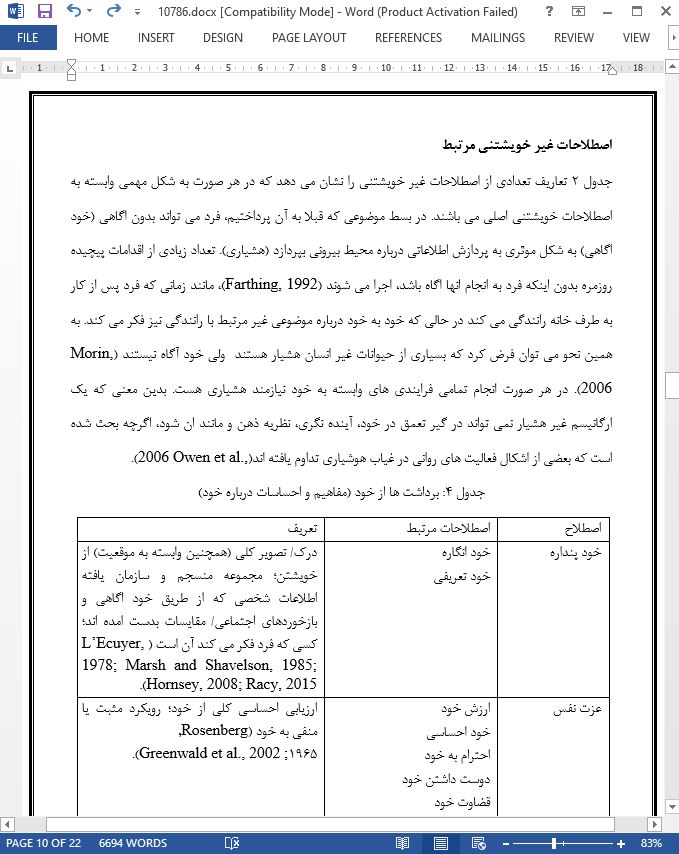
Some scholars have noted that an impressive number of self-related terms have been gradually introduced in the scientific literature. Several of these terms are either ill-defined or synonymous, creating confusion, and redundancy. In an effort to minimize this problem, I present a novel and systematic way of looking at possible relations between several key self-terms. I also propose a tentative classification scheme of self-terms as follows: (1) basic terms related to the overall process of self-perception (e.g., selfawareness), (2) non self-terms that are importantly associated to some other self-terms (e.g., consciousness and Theory of Mind), (3) processes related to the executive self and involving agency, volition, and self-control (e.g., self-regulation), and (4) self-views, that is, the content and feelings about the self (e.g., self-esteem). Three additional categories not discussed in this paper are self-biases, reactions to the self, and interpersonal style. Arguably unambiguous definitions for some of the most important and frequently used self-terms are suggested. These are presented in tables meant for the reader to search for definitions as well as related terms.
INTRODUCTION
Mark Leary offered the following observation in his Editorial for a special issue on “What Is the Self?” in Self and Identity (2004, pp. 2–3):
“... perhaps the field will move slowly to embrace a set of precise, clear, and distinct terms for each of the phenomena that we study under the self and identity umbrella... Whatever terms one uses, providing clear and precise definitions will also help to promote communication and minimize confusion.”
CONCLUSION
An efficient scientific investigation of the self relies on the use of clearly defined terms that describe its multiple underlying operations and functions. One can unfortunately find many examples in the literature of single self-terms being differently defined; another problem consists in the use of different terms to designate the same construct. A unified taxonomy of selfrelated terms is currently lacking and the present paper offers a preliminary framework in that direction. I propose that a parsimonious yet inclusive classification system should include basic terms related to the overall process of self-perception, non-self-terms that are importantly associated to some other selfterms, processes related to the executive self, and self-views. I also look at how various self-terms may be related, suggesting for instance that self-talk represents a fundamental cognitive activity leading to two possible forms of self-focus, self-reflection and selfrumination, themselves linked in complex ways to a host of other positive (e.g., ToM) or dysfunctional (e.g., self-destruction) selfprocesses. I view my proposed model both as a look-up table and as a guide to the many ways in which one might experimentally define and operationalize self-variables.