Abstract
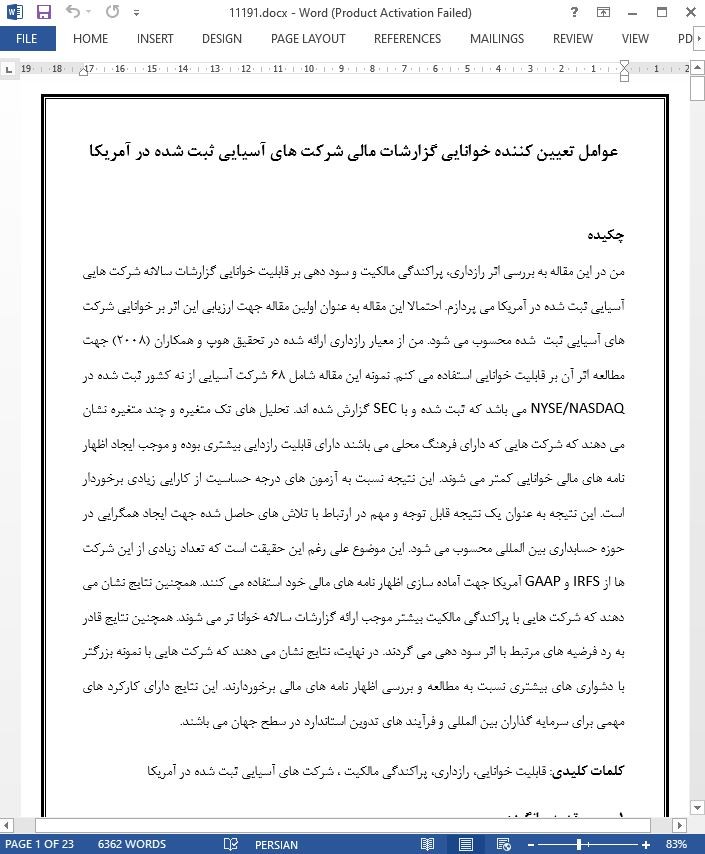
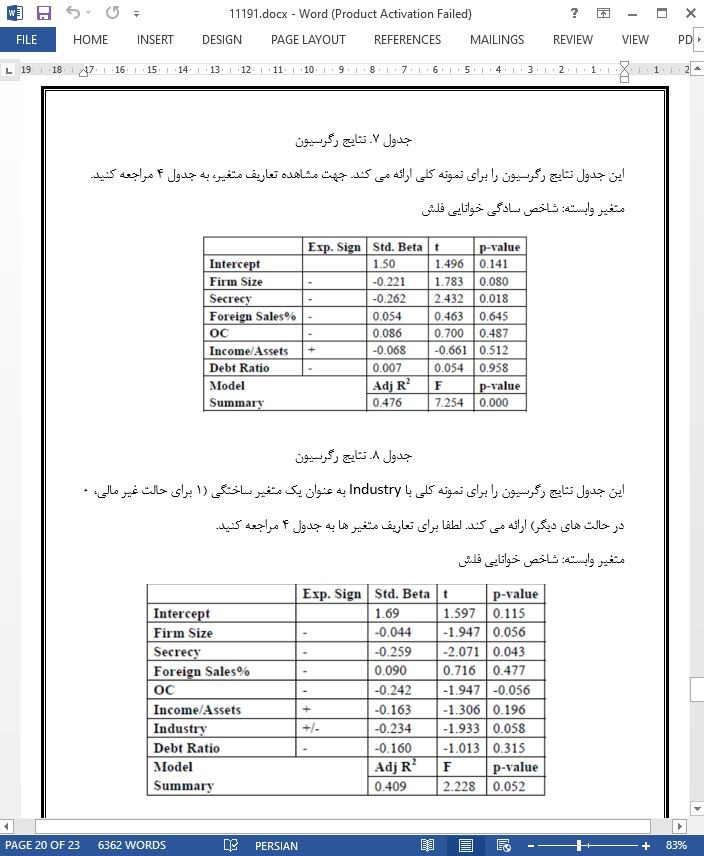
In this paper, I investigate the impact of secrecy, ownership dispersion and profitability on the readability of annual reports of U.S.–listed Asian companies. This is perhaps the first paper to examine the effect on readability of cross-listed Asian companies. I use a measure of secrecy developed in Hope at al. (2008) to study its effect on readability. The sample of this paper consists of all 68 Asian companies from nine countries listed on NYSE/NASDAQ, that are registered and reporting with the SEC. The univariate and multivariate analyses show that companies whose domestic culture is more secretive are providing less readable financial statements. This result is robust to sensitivity tests. This is an interesting and important result in line with the efforts being made to have convergence in the International accounting area. This is despite the fact that a large number of these companies are using IFRS and U.S. GAAP to prepare their financial statements. The results also show that companies with higher ownership dispersion are providing more readable annual reports. The results fail to reject the hypothesis related to the effect of profitability. Finally, the results show that larger sample companies are providing more difficult to read financial statements. These results have important implications for international investors and global standard-setting bodies.
1. Introduction and Motivation
Public companies are required to provide an annual report to their investors. Research has long argued that the disclosures provided in these reports are complex and use “incomprehensible language” (Pashalian and Crissy, 1952). The Securities and Exchange Commission (SEC) has made consistent efforts to make these disclosures more readable in the United States (U.S.). One of these efforts is the plain English disclosure rules adopted by the SEC on January 22, 1998. According to Li (2008), the primary argument for this regulation is that firms could use vague language and format in disclosure to hide adverse information, and average investors may be unable to understand these disclosures leading to capital market inefficiency.
5. Conclusions and Recommendations
This paper examined the following issues: 1) the effect of domestic culture, i.e. secrecy; 2) the effect of agency theory, i.e., ownership dispersion; and 3) the effect of profitability, on the readability of annual reports of U.S. – listed Asian companies. The analyses show that companies whose domestic culture is more secretive are providing less readable financial statements. This result is robust to sensitivity analyses and holds after controlling for size, profitability, complexity of operations, debt ratio and ownership concentration. This is an interesting and important result in line with the efforts being made to have convergence in the International accounting area. This is despite the fact that a large number of these companies are using IFRS and U.S. GAAP to prepare their financial statements.