Abstract
Supply Chain Agility is vital for organisations wanting to remain competitive in today’s dynamic business environment. There is increasing interest in deploying Business Intelligence (BI) in the Supply Chain Management (SCM) context to improve Supply Chain (SC) Agility. However, there is limited research exploring BI contributions to SC Agility. In this research-in-progress paper we propose a model based on a conceptual analysis of the literature showing how BI can help organisations achieve SC Agility by supporting the key areas of SCM (Plan, Source, Make, Deliver, and Return). In the next stage of this project, we will conduct a series of case studies investigating how organisations use BI when managing their SC activities and how BI contributes to SC Agility. The result of the study will help organizations deploy BI effectively to support SCM and improve SC Agility.
1 INTRODUCTION
A single organization is unlikely to have the full capability of bringing products or services to the market to meet changing customer demands. Organizations are frequently forced to form a network to work collectively to meet customer demands. Christopher (1999) refers to such a collective network as a Supply Chain (SC), which is responsible for the planning and management of all activities involved in acquisition, conversion, and delivery of products/services to consumers. SC participants need to work closely together to meet consumer demands rather than competing against each other. Therefore, the nature of competition has shifted from ‘organization against organization’ to ‘Supply Chain against Supply Chain’ (Ketchen et al. 2007). In today’s dynamic environment, flexibility is critical in managing SC so that organisations can deal with market changes and convert these changes into opportunities (Agarwal et al. 2007). The concept of Agile SC has been introduced to define the SC capability that enables an organization to respond to unpredictable changes and uncertainties in dynamic business environment. Achieving SC Agility is challenging and has become a research topic of increasing interest over the last decade.
6 Conclusion and Future Study
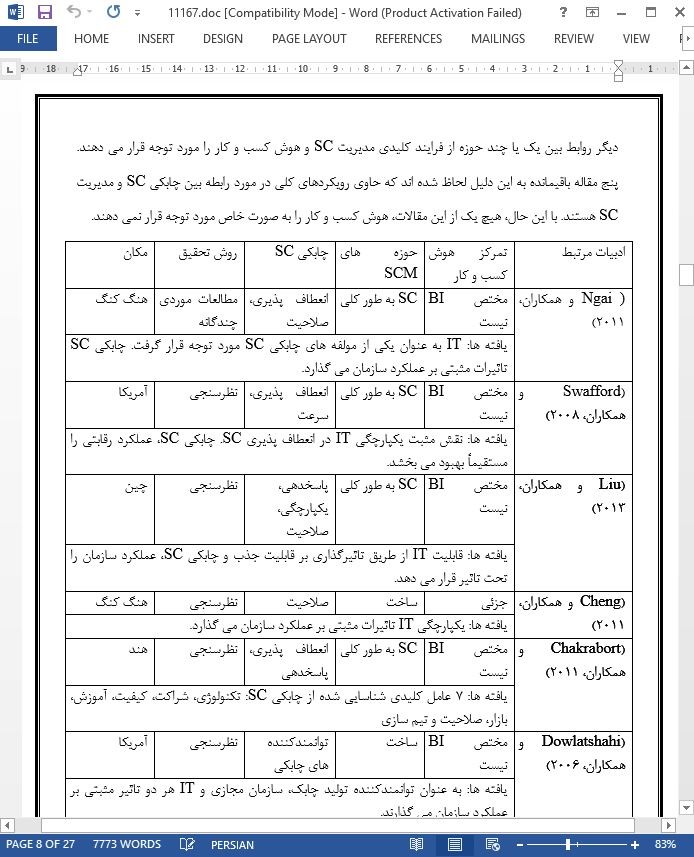
Achieving an agile SC is challenging because of the complexity involved in SCM. In this paper, we discuss the potential for BI use in SCM processes to assist managers in reducing task uncertainty, and making more informed decisions which ultimately assist in achieving SC agility. Based on our review of the existing literature, we identified a number of gaps in the current understanding regarding how SC Agility is achieved. Some existing studies found that IT can be instrumental in achieving SC Agility. However, IT has been considered in a broad sense in most of those studies. Arguably, different IT components such as ERP, BI, Internet and so on may have different effects on SC Agility. In addition, most of the existing studies cover partial aspects of SCM processes and SC Agility. Hence, a comprehensive study is required focusing on specific IT tools, all key SCM processes and all key components of SC Agility.