Abstract
Algorithmic trading and especially high frequency trading is the concern of the current research studies as well as legislative authorities. It is also the subject of criticism mostly from mostly low frequency traders and long-term institutional investors. This is mostly due to several cases of market manipulation and flash crashes in the previous years. Advocates of this trading mechanism claim that it has large positive influence on the market, such as liquidity growth by lowering spreads and others. This paper is focused on testing the relationship between market liquidity of futures traded on EUREX Exchange and HFT activity on European derivative markets. Econometrical methods for time series analysis are used to determine these relations. Results of this paper will reveal the relevance of the HFT trader's main argument about creating liquidity and hence reducing of all the market risks related with high spreads and low number of limit orders.
1. Introduction
Algorithmic trading and more specifically high frequency trading became the most popular trade realization method. It is not only part of trading decision process, but it is also an important tool of order submission process, risk evaluation, data management and market environment predictions. Algorithms have found their place in many segments of world markets including equity, bond, derivatives and commodity markets. In the world largest exchange markets electronic order submission replaced the floor trading. Electronic trading brought much more effectivity on markets and represents the cheaper solutions than replicated work of floor traders or specialists (Hendershott, 2011). This phenomenon is related with the development in other fields. Mathematicians create new models for effective asset pricing, price prediction, data mining and risk optimization. Hardware engineers designe computers that are capable of superfast computation and more important data transmission. Co-location is one of the crucial conditions for HFT traders. Hence they put their servers as close to the exchanges as possible.
5. Conclusion
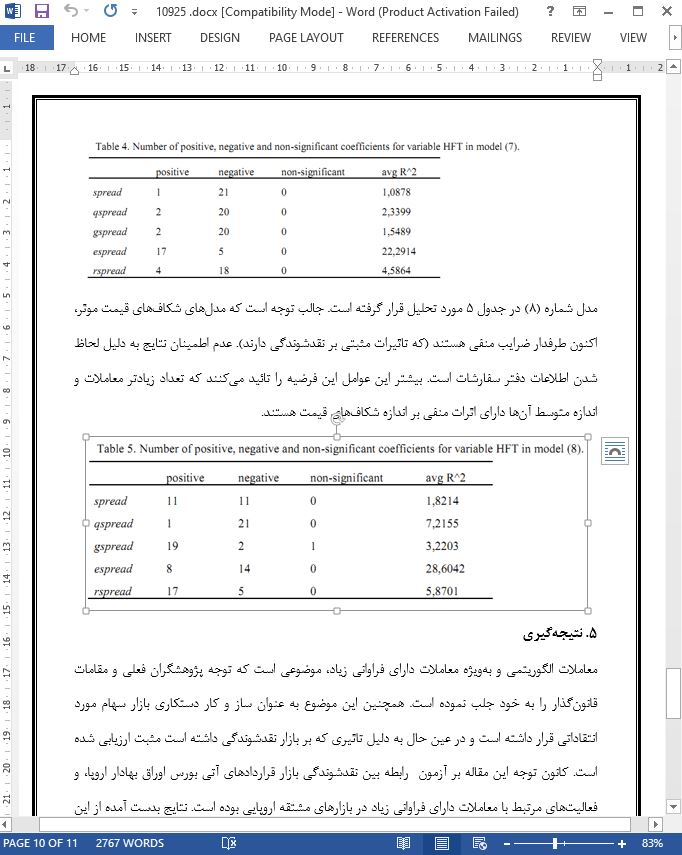
Algorithmic trading and especially high frequency trading is the issue that pays attention of current researchers and legislative authorities. It is also the subject of criticism as a mechanism of market manipulation but simultaneously it is positively rated because of its influence on the market liquidity. This paper was focused on testing the relationship between market liquidity of futures traded on EUREX Exchange and HFT activity on European derivative markets. The model results are mixed and it is influenced by the way of volatility measurements. Although, the mixed results the effect of HFT on market liquidity is positive. The reason of mixed findings might be caused by the usage of proxies for measurement of liquidity because of limited public information about the analyzed market. This way of liquidity measurement will be the subject of our future investigation.