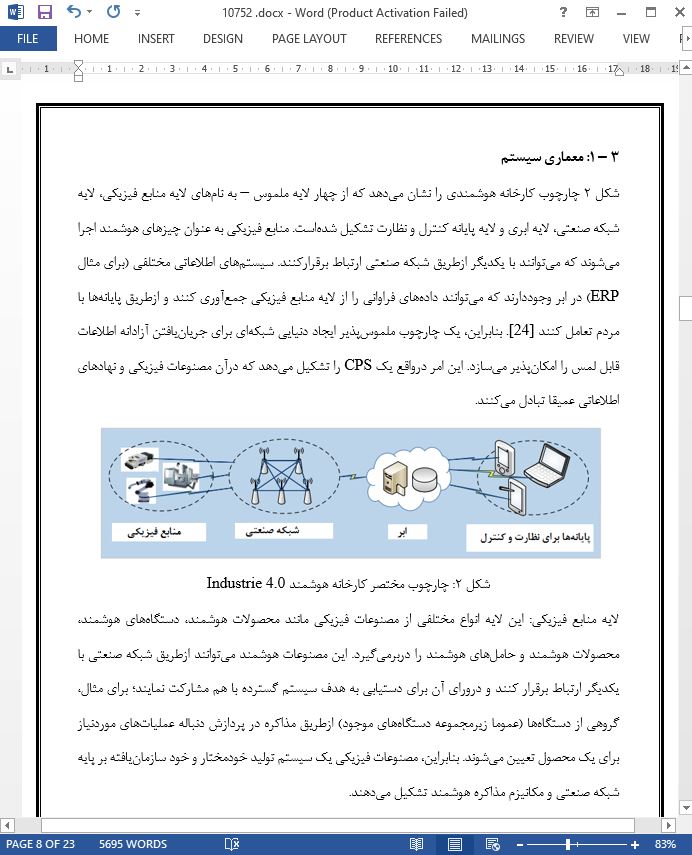
With the application of Internet of Things and services to manufacturing, the fourth stage of industrialization, referred to as Industrie 4.0, is believed to be approaching. For Industrie 4.0 to come true, it is essential to implement the horizontal integration of inter-corporation value network, the end-to-end integration of engineering value chain, and the vertical integration of factory inside. In this paper, we focus on the vertical integration to implement flexible and reconfigurable smart factory. We first propose a brief framework that incorporates industrial wireless networks, cloud, and fixed or mobile terminals with smart artifacts such as machines, products, and conveyors.Then, we elaborate the operational mechanism from the perspective of control engineering, that is, the smart artifacts form a self-organized system which is assisted with the feedback and coordination blocks that are implemented on the cloud and based on the big data analytics. In addition, we outline the main technical features and beneficial outcomes and present a detailed design scheme. We conclude that the smart factory of Industrie 4.0 is achievable by extensively applying the existing enabling technologies while actively coping with the technical challenges.
1. Introduction
Recently, the emerging technologies (e.g., Internet of Things (IoT) [1–3], wireless sensor networks [4, 5], big data [6], cloud computing [7–9], embedded system [10], and mobile Internet [11]) are being introduced into the manufacturing environment, which ushers in a fourth industrial revolution. Consequently, a strategic initiative called “Industrie 4.0” was proposed and was adopted as part of the “High-Tech Strategy 2020 Action Plan” of the German government [12]. The similar strategies were also proposed by other main industrial countries, for example, “Industrial Internet” [13] from USA and “Internet +” [14] from China. The Industrie 4.0 describes a production oriented Cyber-Physical Systems (CPS) [15– 17] that integrate production facilities, warehousing systems, logistics, and even social requirements to establish the global value creation networks [18].
6. Conclusions and Future Wor
k With the emerging information technologies, such as IoT, big data, and cloud computing together with artificial intelligence technologies, we believe the smart factory of Industrie 4.0 can be implemented. The smart machines and products can communicate and negotiate with each other to reconfigure themselves for flexible production of multiple types of products. The massive data can be collected from smart artifacts and transferred to the cloud through the IWN. This enables the system-wide feedback and coordination based on big data analytics to optimize system performance. The above self-organized reconfiguration and big data based feedback and coordination define the framework and operational mechanism of the smart factory.