ABSTRACT
According to experts, implementation of knowledge management processes in research organizations is one of the success factors in a competitive environment with increasing technological change. But in research organizations, one of the main activities during research and development projects is to transfer acquired technology during the process of research and development to industry. This technology transfer happens through a process and various factors can be effective on it’s success and effectiveness. Therefore, in the research, impact of implementation of knowledge management processes in technology transfer projects from institute to industry were studied. Therefore, the above-mentioned processes in Nonaka and Takeuchi 's model of knowledge management were used as independent variables and the dependent variable " technology pressure for product development " referred to in the final stages Lauren model is selected. To investigate this relationship, correlation and regression methods were used. Eventually it became clear that all knowledge management processes include: socialization, combination, internalization, externalization on phase of technology transfer project in product development is effective.
PREFACE
One of the main activities in organizations, working in the field of R&D, is to transfer the acquired technologies to industrial centers. This activity, from idea to product, is completed just when reaching to the phase of mass production and in other words, it is commercialized. Different factors can influence in completion of above-mentioned process and make it easy and fast such as implementation of knowledge Management (KM) processes during the execution of R&D activities and new product transfer to industry. According to the experts, km implementation is among main factors of success and failure in making a product commercialized and mass produced. In this research it is tried to study the impacts of km processes on technology transfer processes from one specific R&D center to industry. This job is done through literature review of km and domain of management of technology, research conceptual framework design, and finally testing hypotheses.
CONCLUSION AND SUGGESTIONS
1. Perfect and flawless implementation of KM processes can lead to successful TT process from institute to industry.
2. Using experiences and activities conducted in products development process can help institute in this way, and informs about the past mistakes , and makes products development process less risky and time consuming.
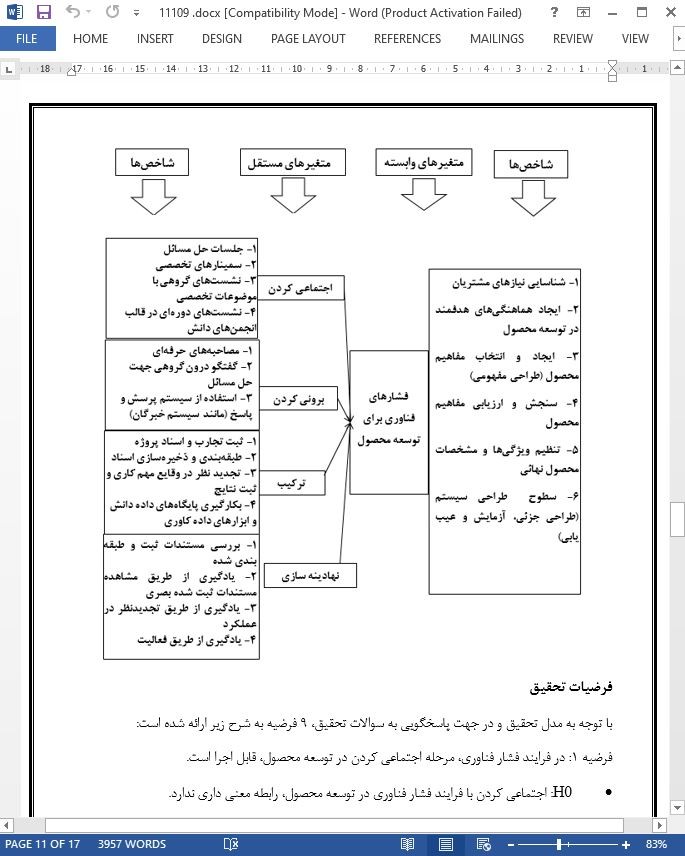
3. Holding group meetings, specialized seminars, brainstorming sessions and and periodic meetings in shape of knowledge societies can facilitate phase of socialization of product development and TT from institute to industry.
4. Specialized interviews, intragroup dialogues and using question and answer systems can conduce to knowledge externalization and converting tacit knowledge to codified knowledge in workforce of TT projects.