

ترجمه مقاله نقش ضروری ارتباطات 6G با چشم انداز صنعت 4.0
- مبلغ: ۸۶,۰۰۰ تومان
ترجمه مقاله پایداری توسعه شهری، تعدیل ساختار صنعتی و کارایی کاربری زمین
- مبلغ: ۹۱,۰۰۰ تومان

1. مقدمه
2. روند آزمایشگاهی
2.1 مواد
2.2 درصد نمونه های کامپوزیت MWCNT/ اپوکسی
2.3 تعیین مشخصات
3. نتایج و بحث
3.1 خصوصیات ریزساختاری
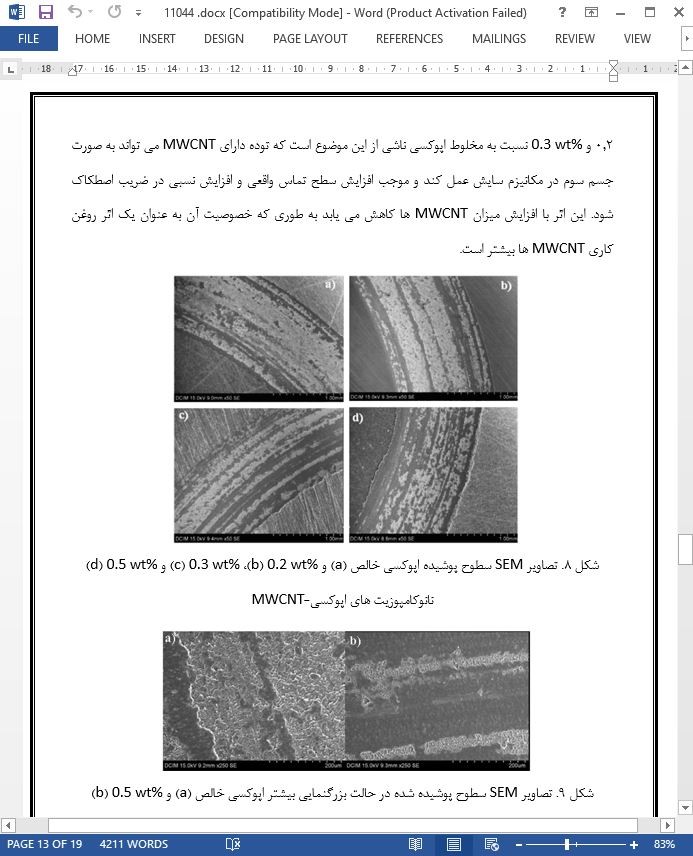
3.2 خصوصیات تریبیولوژیکی
4. نتیجه گیری
In this work the wear behaviour of epoxy matrix composites with different types and percentages of multiwalled carbon nanotubes (MWCNTs) has been studied. Three different types (NC3100, NC3150 and NC3152) and percentages (0.1 and 0.5 wt%) of MWCNTs were dispersed into an epoxy resin by a calendering process. The tribological properties of epoxy-MWCNTs nanocomposites were investigated using “pin-on disc” wear testing machine under different conditions (counterpart material, distances and sliding speeds test). Scanning electron microscopy and 3D optical profilometer were used to observe the worn surfaces of the samples. Compared with neat epoxy, the composites with MWCNTs showed a lower mass loss, friction coefficient and wear rate, and these parameters decreased with the increase of MWCNT percentage. Also, the results demonstrated that the epoxy composites with 0.5 wt% of amino-MWCNT (NC3152) have the best tribological properties.
1. Introduction
Polymers are being used in components subjected to wear due to their advantages such as easy processing, good corrosion resistance and low friction and vibration damping. However, the load carrying capacity and thermal resistance are lower than those of metals and ceramics. To improve these properties, nanoreinforcements such as carbon nanofibers or nanotubes could be added to the polymer. These nanoreinforcements exhibit excellent mechanical, electrical and thermal properties. For this reason, in recent years extensive research has been done on the improvement in the mechanical and electrical properties that is caused by the addition of these nanoreinforcements to the polymer matrices [1–3]. Besides, the carbon nanotubes (CNTs) have self-lubricating properties due to their structure which is similar to the structure of graphite and fullerenes. Therefore, the CNTs could be suitable for anti-friction materials and abrasion resistance.
4. Conclusions
This study investigated the effect of type and percentage of MWCNTson thewearbehaviour ofthe epoxy-MWCNTs nanocompositesin dry sliding against alumina ball. The main conclusions of the research are the following:
1. The mechanical dispersion of carbon nanotubes by the calendering process allows obtaining homogeneous and uniform mixtures for the three types and different percentages of carbon nanotubes studied.
2. The addition of MWCNTs to the epoxy matrix significantly improves its wear behaviour. Compared with neat epoxy, the composites with MWCNTs showed lower mass loss, wear rate and friction coefficient. These improvements are greater with increasing percentage of MWCNTs and for longer carbon nanotubes (NC3100) and functionalised with amino group (NC3152).
3. The wear mechanisms of neat epoxy and nanocomposites with MWCNTs are mainly abrasion and adhesion wear. The adhesive and abrasive mechanisms wear decreases with the increase of MWCNTs percentage and the amino-MWCNTs.
4. The nanocomposites with 0.5wt% amino MWCNTs (NC3152) had the better wear behaviour. For this material, the amount removed and the worn surface was smaller due to the greater interaction of these carbon nanotubes with the epoxy matrix.
در این تحقیق، رفتار سایشی کامپوزیت های ماتریس اپوکسی با انواع و درصد های متفاوت نانولوله های کربنی چند جداره (MWCNTها) مطالعه شده است. سه نوع (NC3100,NC3150 و NC3152) و درصد های متفاوت (0.1 و 0.5 wt%) MWCNT ها در یک رزین اپوکسی به وسیله یک فرآیند کلندرکردن منتشر شده اند. خصوصیات تریبیولوژیکی نانوکامپوزیت های MWCNT ها-اپوکسی با استفاده از دستگاه آزمایش سایش پین روی دیسک تحت شرایط مختلف (مواد مشابه، فواصل و آزمایش سرعت های لغزش) مورد بررسی قرار گرفته اند. میکروسکوپ الکترونی روبشی و نیمرخ سنج اپتیکال سه بعدی جهت مشاهده سطوح پوشیده شده نمونه ها مورد استفاده قرار گرفتند. در مقایسه با اپوکسی خالص، کامپوزیت های دارای MWCNT ها دارای تلفات (کاهش) جرم، ضریب اصطکاک و نرخ سایش کمتر بوده و این پارامتر ها با افزایش درصد MWCNT کاهش یافته اند. همچنین، نتایج نشان می دهند که کامپوزیت های اپوکسی با 0.5 wt% آمینو- MWCNT (NC3152) دارای بهترین خصوصیات تریبیولوژیکی هستند.
1. مقدمه
پلیمرها در عناصر و قطعات تحت سایش به دلیل مزیت های آنها مانند فرآوری ساده، مقاومت خوردگی مناسب و اصطکاک کم و میرایی ارتعاشی مورد استفاده قرار می گیرند. با این حال، ظرفیت باربری و مقاومت حرارتی آنها کمتر از فلزات و سرامیک ها هستند. به منظور بهبود این خصوصیات، نانوتقویت کننده ها مانند نانوالیاف های کربنی یا نانولوله ها به پلیمر افزوده می شوند. این نانوتقویت کننده ها دارای خصوصیات مکانیکی، الکتریکی و حرارتی بسیار خوبی هستند. به همین دلیل، در طی سال های اخیر تحقیقات گسترده ای در مورد بهبود خصوصیات مکانیکی و الکتریکی ناشی از افزودن این نانوتقویت کننده ها به ماتریس های پلیمری انجام شده است. همچنین، نانولوله های کربنی (CNT ها) دارای خصوصیات خود روغن کاری به دلیل ساختار خود هستند که مشابه با ساختار گرافیت و فولرن ها است. بنابراین، CNT ها می توان برای مواد ضد اصطکاک و مقاومت سایش مناسب باشند.
4. نتیجه گیری
این تحقیق به بررسی اثر نوع و درصد MWCNT ها بر روی رفتار سایش نانوکامپوزیت های اپوکسی- MWCNT در حالت لغزش خشک نسبت به توپ آلومینا می پردازد. نتایج اصلی این تحقیق عبارتند از:
1. انتشار مکانیکی نانولوله های کربنی به وسیله فرآیند کلندرینگ موجب به دست آوردن مخلوط های همگن و یکنواخت برای سه نوع و درصد تفاوت نانولوله های کربنی به دست آمده می شود.
2. افزودن MWCNT ها به مخلوط اپوکسی به طور قابل توجه موجب بهبود رفتارسایش آن می شود. در مقایسه با اپوکسی خالص، کامپوزیت های دارای MWCNT ا دارای کاهش جرم، نرخ سایش و ضریب اصطکاک کمتر هستند. این موارد با افزایش درصد MWCNT ها و برای نانولوله های کربنی بلند تر (NC3100) و عامل دار شده با گروه آمینو (NC3152) بیشتر مشاهده می شود.
3. مکانیزم های سایش اپوکسی خالص و نانوکامپوزیت ها با MWCNT ها به صورت سایشی می باشند. مکانیزم های سایش با افزایش درصد MWCNT ها و آمینو- MWCNT ها کاهش می یابد.
4. نانوکامپوزیت های دارای 0.5wt% آمینو MWCNT (NC3152) دارای رفتار سایش بهتر هستند. در مورد این ماده، مقدار سطح پوشیده شده و حذف شده به دلیل برهم کنش بهتر نانولوله های کربنی با مخلوط اپوکسی کمتر است.

