Abstract
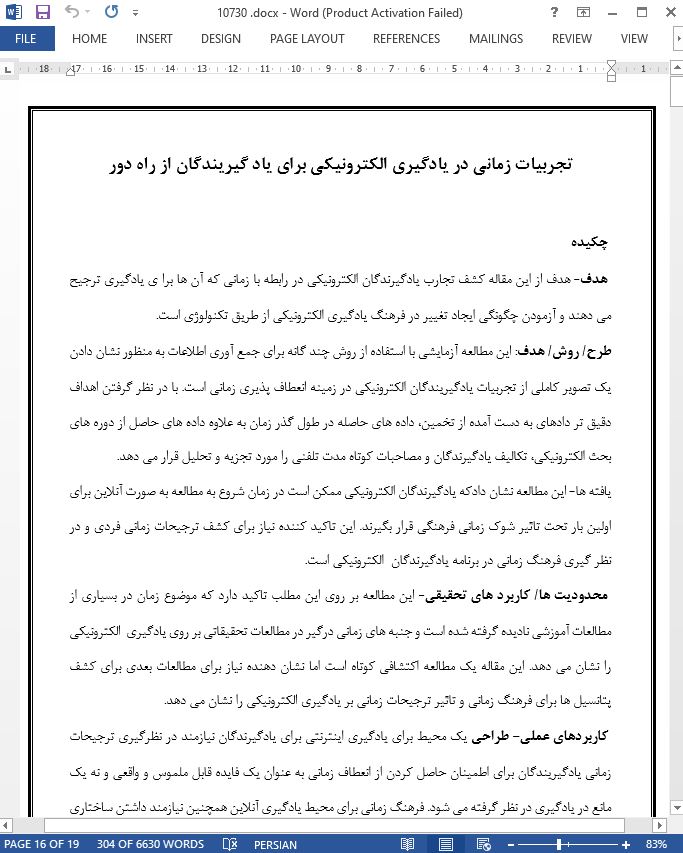
Purpose The purpose of this paper is to explore experiences of e-learners in relation to their time preferences, and to examine how technology changes temporal culture in e-learning.
Design/methodology/approach A pilot study using multiple methods of data collection to provide a rich picture of the experience of e-learners in relation to temporal flexibility. Taking a narrative approach it analysed data from a survey, time tracking data as well as data from online discussion boards, learners’ assignments and short telephone interviews.
Findings The study found e-learners may experience temporal culture shock when starting to study online for the first time. It highlights the need to explore an individual's time preference and to consider the temporal culture of the e-learning programme.
Research limitations/implications It highlights that the issue of time is still missing from educational studies and suggests that temporal aspects are included in e-learning research studies. This is a small exploratory study but it indicates the need for further research to explore the potential for temporal culture shock and influence of e-learner time preferences.
Practical implications Designing an e-learning environment for learners needs to consider learner time preferences to ensure that temporal flexibility is a realised benefit, not a barrier to learning. The temporal culture of the online learning environment also needs to be made explicit so that learner expectations can be managed.
Originality/value It contributes to the literature on e-learning in the higher education context by providing a temporal lens to explore learner experiences. It is of value to educationalists and learning technologists designing, delivering or evaluating e-learning programmes. Online learners may also benefit from its findings.
Introduction
The introduction of technology enhanced learning alters the use of both teachers’ and learners’ time (Laurillard, 2007) and yet the role of time is rarely highlighted in educational research into e-learning (Thorpe, 2006). This is surprising given that the literature concerning the use of technology in e-learning is replete with references to time in the form of synchronous and asynchronous interaction. Where time is discussed it is often in the form of time management (Kordaki, 2011) or the time it takes to learn new skills and manage new forms of communication (Salmon, 2000). Barbera and Clara` (2012) in their systematic literature review highlight that time has been neglected in e-learning research even though it is often noted as a key requirement in general teaching and learning, and that the use of technology is frequently offered as a solution to temporal difficulties. Many e-learning tasks are described in terms of their temporal characteristics (synchronous or asynchronous) and the temporal flexibility afforded by e-learning programmes is often promoted as a benefit to the learner. However, Allan (2007) argues that the flexible approach that e-learning offers may be undermined if the concept of time is overlooked or not made explicit.
Conclusions
Although this research is only a small exploratory study it has highlighted that new technologies have prompted a change in the temporal culture of learning and therefore educational institutions need to carefully consider the design and delivery of e-learning programmes. Online learning alters the temporal culture from discontinuous to continuous where tutor led learning activities are moved from a specific place and clock time to task-based activities where spatial location, timing and temporal duration become the responsibility of the learner. This has a number of implications for both the e-learner and the educational institution. If individual learners have different time preferences ranging from monochronic to polychronic and therefore different temporal approaches to e-learning, then higher education institutions need to consider how all e-learners can be supported. Learners with a polychronic time perspective and a tendency to unintentional or blended approaches to e-learning will need to be given different types of support and guidance than those with a monochronic view and a preference for a more rigid planned approach. Recommendations for the future design and delivery of online programmes and in particular for the module studied in this research have been made by the researcher. Module tutors have been asked to make explicit the time to be spent on learning activities. In particular the timing and duration for discussion board activity has been incorporated into all modules. A recommendation to include some discussion of temporal preferences during course induction has also been suggested.