ABSTRACT
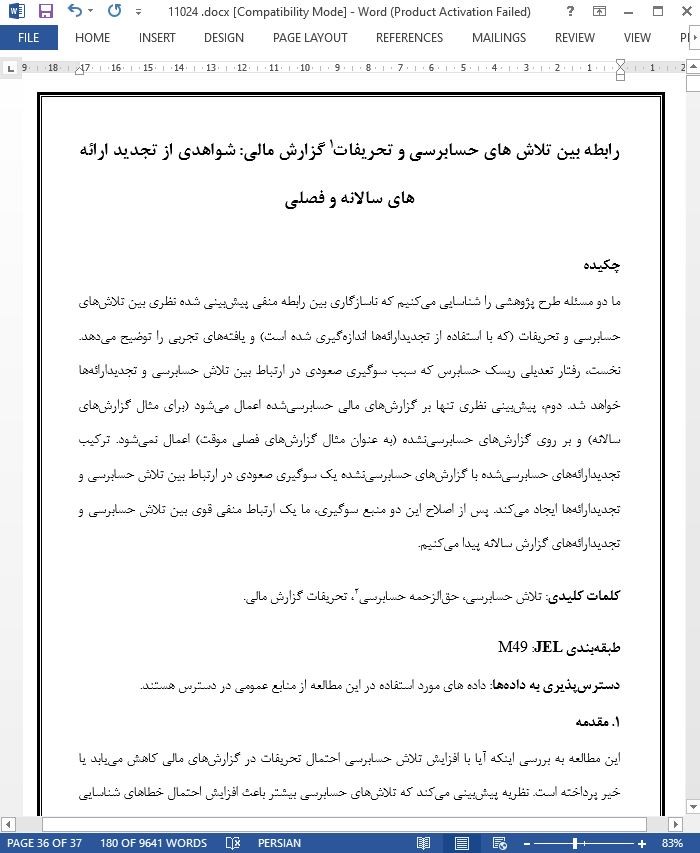
We identify two research design issues that explain the inconsistency between the theoretically predicted negative relation between audit effort and misstatements (measured using restatements) and empirical findings. First, auditor risk adjustment behavior induces an upward bias in the association between audit effort and restatements. Second, the theoretical prediction applies only to audited financial reports (i.e., annual reports) and not to unaudited reports (i.e., interim quarterly reports). Comingling restatements of audited with unaudited reports introduces an additional upward bias in the association between audit effort and restatements. After correcting for these two sources of bias, we find a robust negative association between audit effort and annual report restatements.
I. INTRODUCTION
This study examines whether the likelihood of misstatements in financial reports decreases as audit effort increases. Theory predicts that higher audit effort increases the likelihood of detected errors and reduces the likelihood of undetected errors (Shibano 1990; Matsumura and Tucker 1992; Dye 1993; Hillegeist 1999), implying a negative relation between current-year audit effort and subsequent restatement of current-year financial reports. Despite its importance for audit research, few empirical studies have explicitly tested this theoretical prediction. The most relevant among those studies is Hribar et al. (2010), but they find a positive association between current-year audit effort, measured by audit fees, and the probability of restatements. We posit that two reasons for this inconsistency between the theoretical prediction and empirical findings are (1) the empirical tests’ failure to control for auditor risk adjustment, and (2) the empirical tests’ failure to separate restatements of audited financial reports from restatements of unaudited reports, both of which positively bias the estimated relation between audit effort and subsequent restatements. We provide empirical evidence consistent with these explanations.
VI. SUMMARY AND CONCLUSIONS
In this study, we reconcile the discrepancy between the theoretical prediction and empirical evidence on the association between audit effort and subsequent restatements. We document that auditor risk adjustment and the positive relation between audit effort and quarterly restatements induce two upward biases that obscure the predicted negative association between audit effort and annual restatements. We show that after appropriately controlling for these two biases, audit effort has a robust negative association with annual restatements.
Restatement is arguably one of the most objective indicators of audit quality. However, due to the two sources of bias discussed in this paper, prior research has not been successful at documenting the value of the audit in preventing restatements. We propose ways to overcome this hurdle. Future studies could explore other factors affecting the magnitude of the negative association between audit effort and restatements. We believe research in this direction will further our understanding of audit quality and provide valuable information to investors, auditors, and regulators.