Abstract
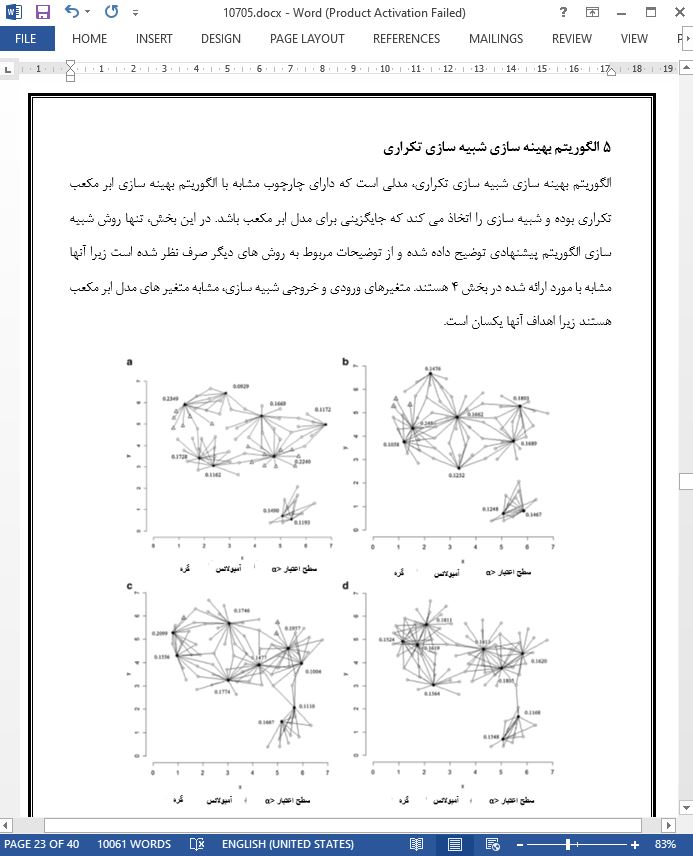
The emergency vehicle location problem to determine the number of ambulance vehicles and their locations satisfying a required reliability level is investigated in this study. This is a complex nonlinear issue involving critical decision making that has inherent stochastic characteristics. This paper studies an iterative optimization algorithm with parameter estimation to solve the emergency vehicle location problem. In the suggested algorithm, a linear model determines the locations of ambulances, while a hypercube simulation is used to estimate and provide parameters regarding ambulance locations. First, we suggest an iterative hypercube optimization algorithm in which interaction parameters and rules for the hypercube and optimization are identified. The interaction rules employed in this study enable our algorithm to always find the locations of ambulances satisfying the reliability requirement. We also propose an iterative simulation optimization algorithm in which the hypercube method is replaced by a simulation, to achieve computational efficiency. The computational experiments show that the iterative simulation optimization algorithm performs equivalently to the iterative hypercube optimization. The suggested algorithms are found to outperform existing algorithms suggested in the literature.
1 Introduction
In an emergency medical service system (EMS), the ambulance location problem (ALP) is a critical issue. Locating ambulances is crucial to providing timely emergency medical services, affecting patients’ lives intimately. The ALP can be defined as the problem to find the number and locations of ambulances needed to provide a certain level of timely service. The location set cover problem (LSCP), which is to minimize the number of vehicles required to cover all demand sites within a specific distance, is an effective approach used to model the ALP. However, the LSCP is not able to capture the most important characteristic of the ALP: unavailability of an ambulance, such as when it is occupied by a patient, which leads to the late arrival of the ambulance at the target location, thus decreasing the patient’s chances of survival. Therefore, it is important to build a reliable ambulance location model.
7 Conclusions
This paper suggested an iterative hypercube and simulation optimization algorithm for the purpose of finding the locations of ambulances that satisfy the reliability requirements. The optimization model of the suggested algorithms finds the number and locations of ambulances using simple linear constraints. The hypercube (simulation) model was used to validate the optimization model results, and a few parameters required to interact between the models for the purpose of validation were identified. These interaction parameters were updated iteratively until satisfaction of the termination conditions, thus ensuring a feasible solution. The comparison experiment of HYP-OPT and SIM-OPT showed that the two algorithms have approximately equivalent performances. The experimental results of SIM-OPT were compared with other mathematical programming algorithms, and it is evident from the statistics presented that the suggested algorithm is efficient in terms of the number of allocated vehicles. That is, it found a lower number of ambulances on average compared to the other algorithms for the cases in which the others found feasible solutions. In the other cases, it employed only 0.3815 more vehicles than the other models on average while satisfying the reliability requirement (computational time per case was observed to be<1 h). The limitations of this paper include the assumption that the required numbers of ambulances per demand node and the maximum utilizations of each ambulance are the same. The rules for updating the parameter zij hyper could be revised to impose a tight boundary on it in the optimization model. Future research is suggested to investigate an iterative algorithm that considers travel time and demand per period.