Abstract
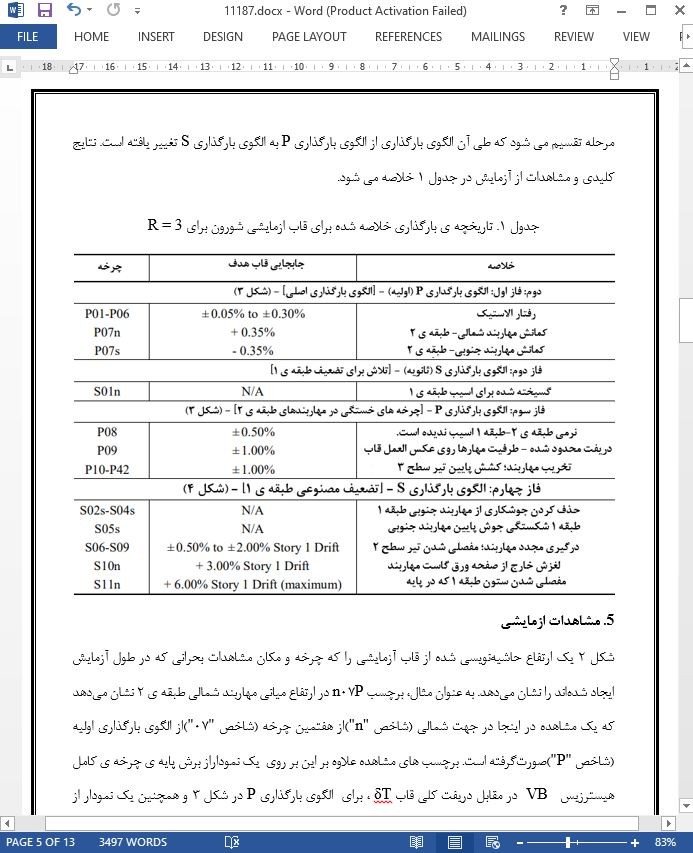
Steel concentrically-braced frames (CBFs) are used extensively as lateral-force-resisting systems for low to mid-rise buildings in moderate seismic regions of the United States, such as the East Coast and Midwest. Although good structural performance of CBFs in moderate seismic regions for typical gravity and wind loading is well-established, there is essentially no data for earthquake loading. As a result of this situation, a research project was initiated to investigate the seismic performance of CBFs in moderate seismic regions. This paper summarizes one aspect of the project: a full-scale cyclic test of a one-bay two-story CBF designed assuming R=3 and not specifically detailed for seismic resistance – focusing on the sequence of limit states and associated system behavior. The frame experienced brittle brace buckling in both upper story braces at ±0.35% frame drift. Brace-to-gusset weld fracture was subsequently induced in the lower story to observe the influence of brace re-engagement on system strength.
1 INTRODUCTION
Ductile lateral-force-resisting systems, which were developed through research documenting their nonlinear behavior, are used extensively in high seismic regions. These systems – such as special moment resisting frames (SMRFs) or special concentrically-braced frames (SCBFs), are created using capacitybased design procedures with comprehensive detailing requirements such that brittle behavior is avoided. In contrast, lateral-force-resisting systems (LFRSs) used in moderate seismic regions typically have modest or no ductile detailing requirement and capacity-based design procedures, and there is little experimental data related to the nonlinear behavior of these more brittle structural systems. For example, steel concentrically-braced frames (CBFs) are used widely for low to mid-rise buildings in the East Coast and Midwest of the United States because of their high stiffness-to-weight ratio in the elastic range, but their inelastic seismic performance is essentially unstudied.
6 SUMMARY AND CONCLUSIONS
Full-scale testing of a two-story R=3 chevron concentrically-braced frame (CBF) has provided valuable new data on the cyclic behaviour of braced frames not specifically detailed for seismic resistance. Common to moderate seismic regions and popular because of their economy, R=3 frames are more susceptible to experience brittle limit states due to lack of seismic detailing. During this test, both Story 2 braces experienced a brittle buckling mechanism with significant loss of strength. This is in contrast to the other full-scale test performed by the authors on an R=3.25 ordinary concentrically-braced frame (OCBF), which experienced more ductile brace buckling behavior as expected due to its modest seismic detailing requirements [4]. Despite the relatively brittle brace buckling in the R=3 test described here, the frame still maintained a capacity of 445kN [100 kip] to Story 2 drifts upwards of 2%, identifying the reserve capacity achievable from the connections, frame action and the buckled braces. The maximum base shear achieved under a loading protocol mimicking the equivalent lateral force distribution used in design was 2060 kN [464 kip], nearly 40% more than the design base shear of 1500 kN [336 kip].