The purpose of these remarks is to com ment on directions in accounting research: NEAR (Not-so Early Accounting Research) and FAR (Future Accounting Research), focus ing on capital market research. The topic pro vides an opportunity to synthesize recent re search trends and to speculate on which are likely to continue and why. As is often the case, the reasons given for expecting certain trends to continue can be more informative than whether they turnout to be accurate.
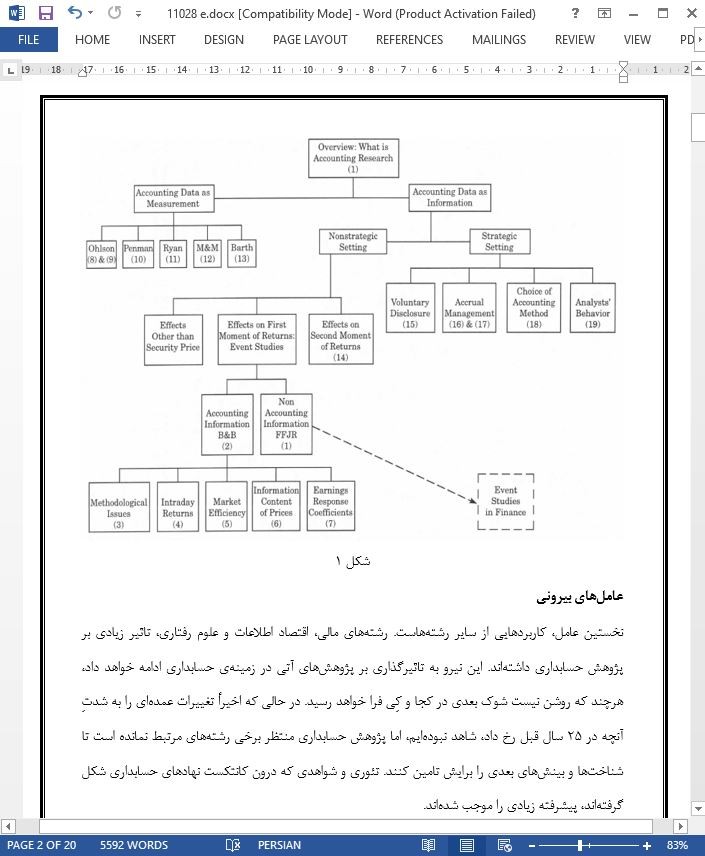
My comments focus on three areas. First, I review the forces that have influenced ac counting research over the last 25 years. Sec ond, a portion of NEAR directions is reviewed using two personal focal points-the set of research papers discussed in the accounting security price research seminar at Stanford and the set of research papers that constitute my current research interests. Third, I discuss the major characteristics of FAR directions, including ingredients which tend to lead to good accounting research, the benefits of ge neric versus contextual research, and finally the role of "wild card" factors.
FEATURES OF FUTURE ACCOUNTING RESEARCH (FAR)
The discussion of NEAR identified several trends in accounting research. I conclude by emphasizing three major factors.
The first is that outstanding accounting research is likely to be a blend of theory, em pirical analysis and institutional knowledge. Research that incorporates all three is rare. The work of Scholes and Wolfson (1987) is a fine example of this type of research. Their work relies upon micro-economic theory that blends a variety of factors including taxes, incentives and risk sharing. They have inte grated a traditional area of accounting re search into a broader scheme of micro-eco nomic behavior. They derive and test several predictions in a series of empirical studies. Their work is not simply a discussion of taxes and institutional arrangements in the abstract but also fully incorporates the rich institu-tional structure of tax laws and the regula tory environment.